
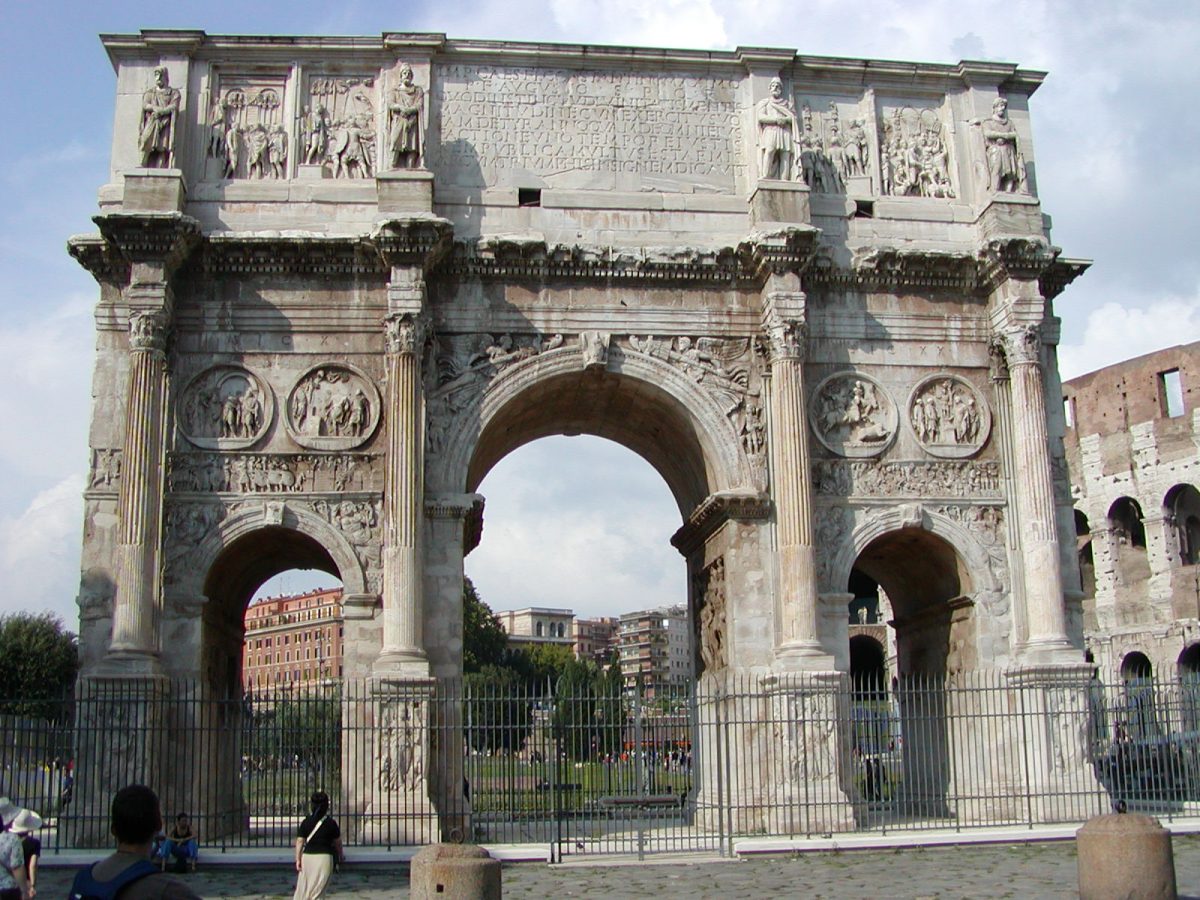
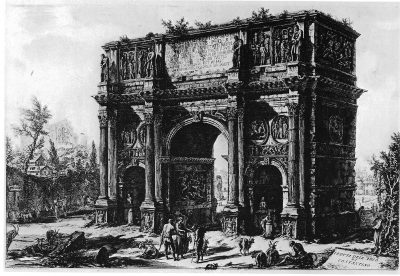
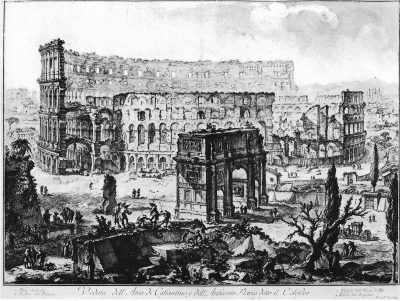
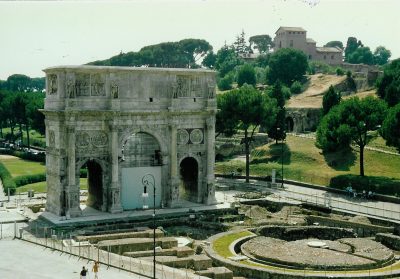
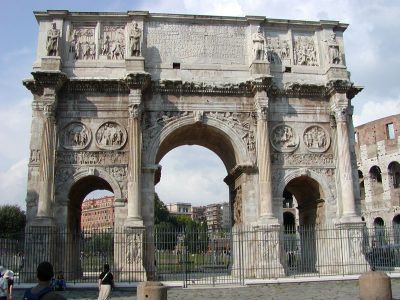
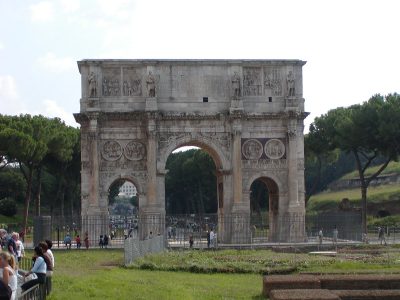
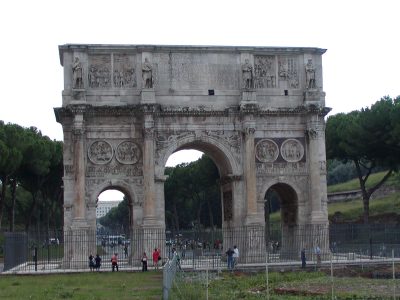
The Arch of Constantine is a triumphal arch, erected c. 315 CE to commemorate the triumph of Constantine I after his victory over Maxentius in the battle at the Milvian Bridge in 312 CE. The arch is located in the valley of the Colosseum, between the Palatine Hill and the Colosseum, along the road taken by the triumphal processions.
The arch is the largest of only three such arches to survive in Rome today. The two others are the Arch of Titus and the Arch of Septimius Severus, both in the nearby Forum Romanum.
The historical background
The battle of the Milvian Bridge in 312 CE was the decisive moment in Constantine’s quest for power. He had been proclaimed Augustus by the troops in Britain in 306 CE, after the death of his father in York, and even though he had no legal right to that title, he refused to relinquish it. Likewise, Maxentius claimed the title of Augustus of the western empire. The conflict was finally resolved in the battle of the Milvian Bridge just N. of Rome, when Constantine’s army defeated the numerically superior but less experienced troops of Maxentius. Maxentius perished while trying to flee across the Tiber River, as a temporary bridge made of boats collapsed under him and his troops.
Constantine entered Rome victoriously, and the senate awarded him a triumphal arch. Construction began immediately, and the arch was finished in a few years, to be consecrated in 315/316 CE on the tenth anniversary of Constantine’s rise to power.
The monument is not mentioned by any ancient source, but it is clearly identified by the inscription. The year of dedication is written on the arch itself: “Votis X”.
Sculptures and reliefs
The Arch of Constantine is a three-way arch, measuring 21m in height, 25.7m in width and 7.4m in depth. The central archway is 11.5m high and 6.5m wide, while the lateral archways are 7.4m×3.4m.
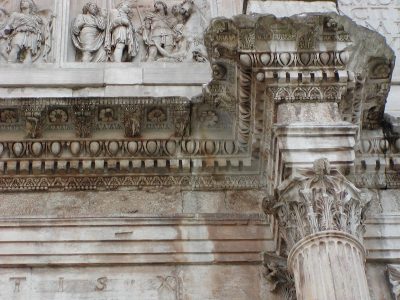
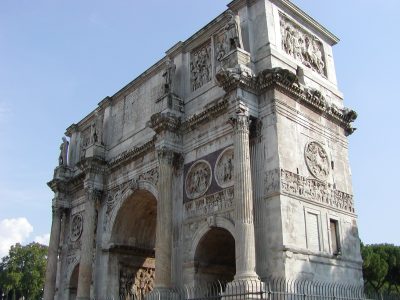
Eight detached Corinthian columns, four on each side, stand on plinths on the sides of the archways.
The lower part, the arches and supporting piers, is build of white marble in opus quadratum, while the attic is opus latericium covered with marble slabs. The different construction techniques might indicate different construction times for the two parts, as some theories argue.
The decorative elements on the monument are from different periods and are generally considered to be spolia, that is, parts taken from earlier monuments. The arch has parts from the reigns of Trajan, Hadrian, Marcus Aurelius and Constantine himself. Some of the older, reused parts have been changed to give the images of former emperors the semblance of Constantine.
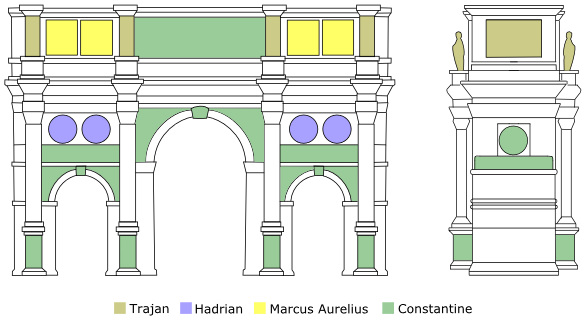
In the following two sections the individual decorative elements are described in detail.
Reuse from Older Monuments
Many parts of the decorations of the Arch of Constantine are taken from other monuments erected by earlier emperors: Trajan, Hadrian and Marcus Aurelius, who were known already in the time of Constantine as the Good Emperors. That the reused parts come from precisely these emperors is definitely not a coincidence. Constantine wanted to likened to them.
In this section the small images on the right are clickable and lead to pages with larger versions of the pictures. Letting the the mouse hover shortly over a thumbnail will show a balloon-text with further information.
The Trajanic Statues and Reliefs
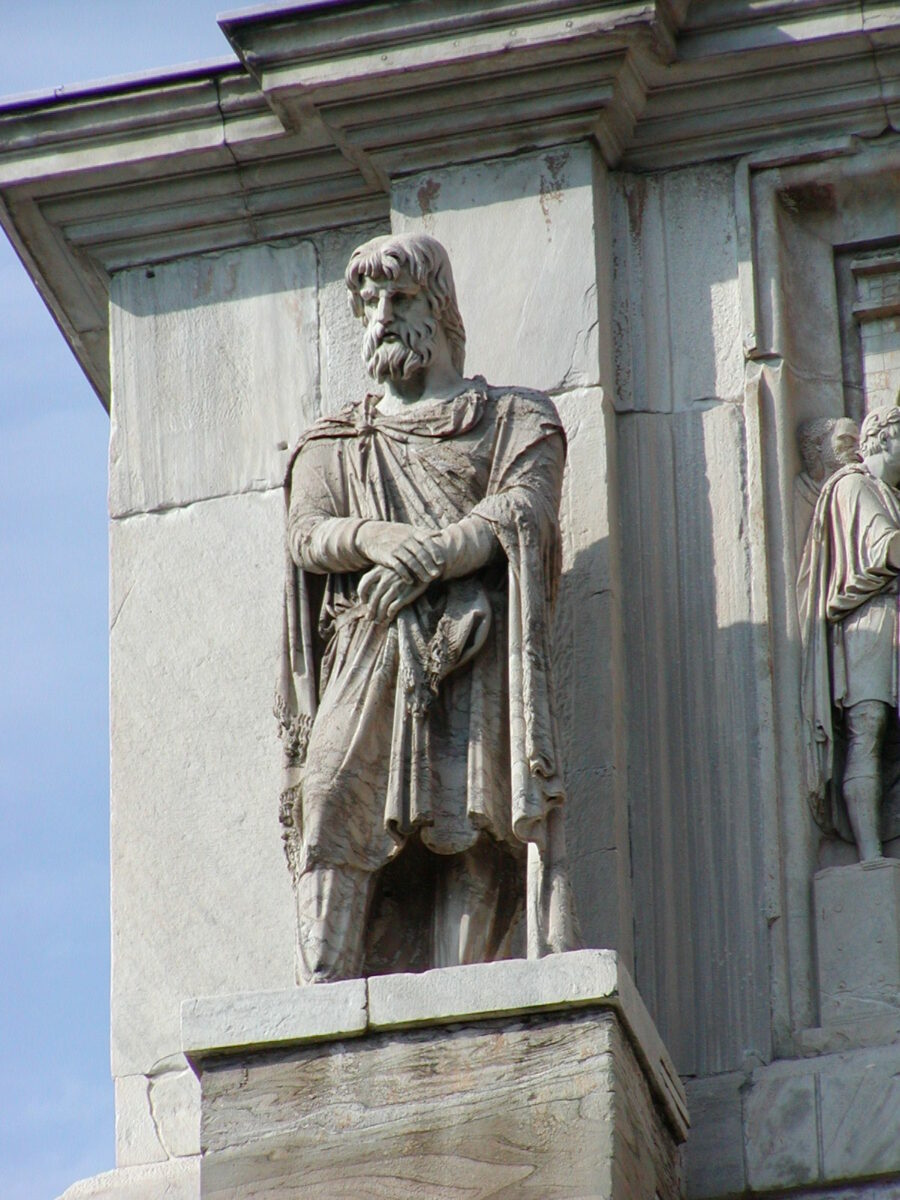
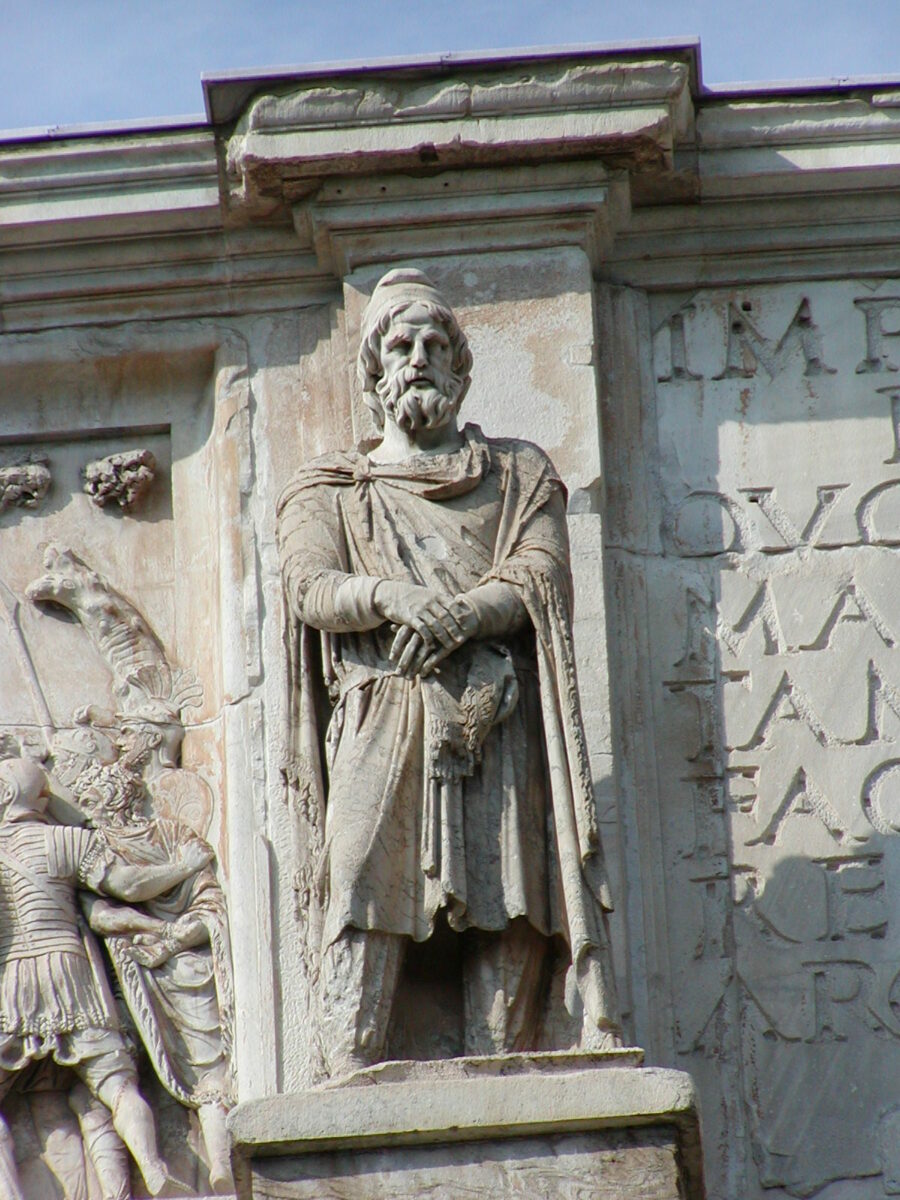
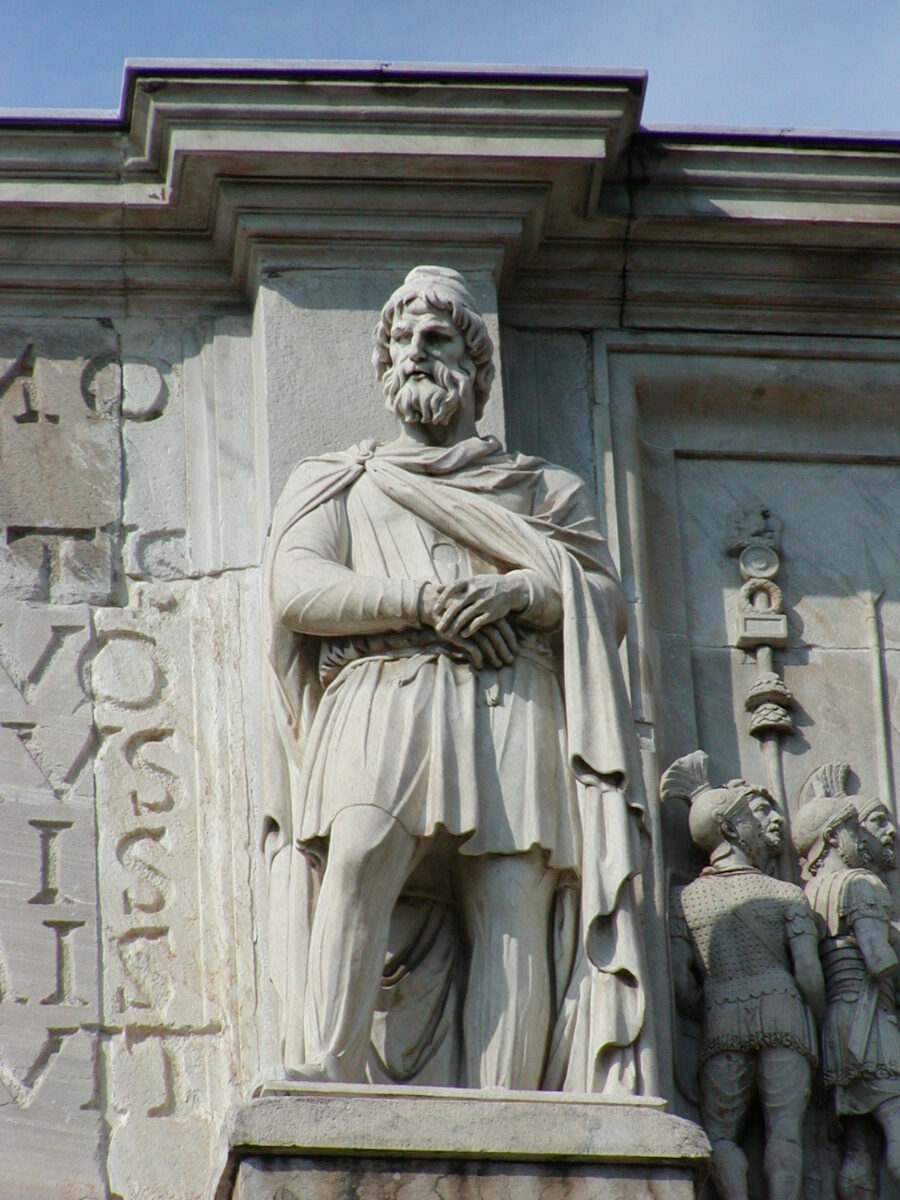
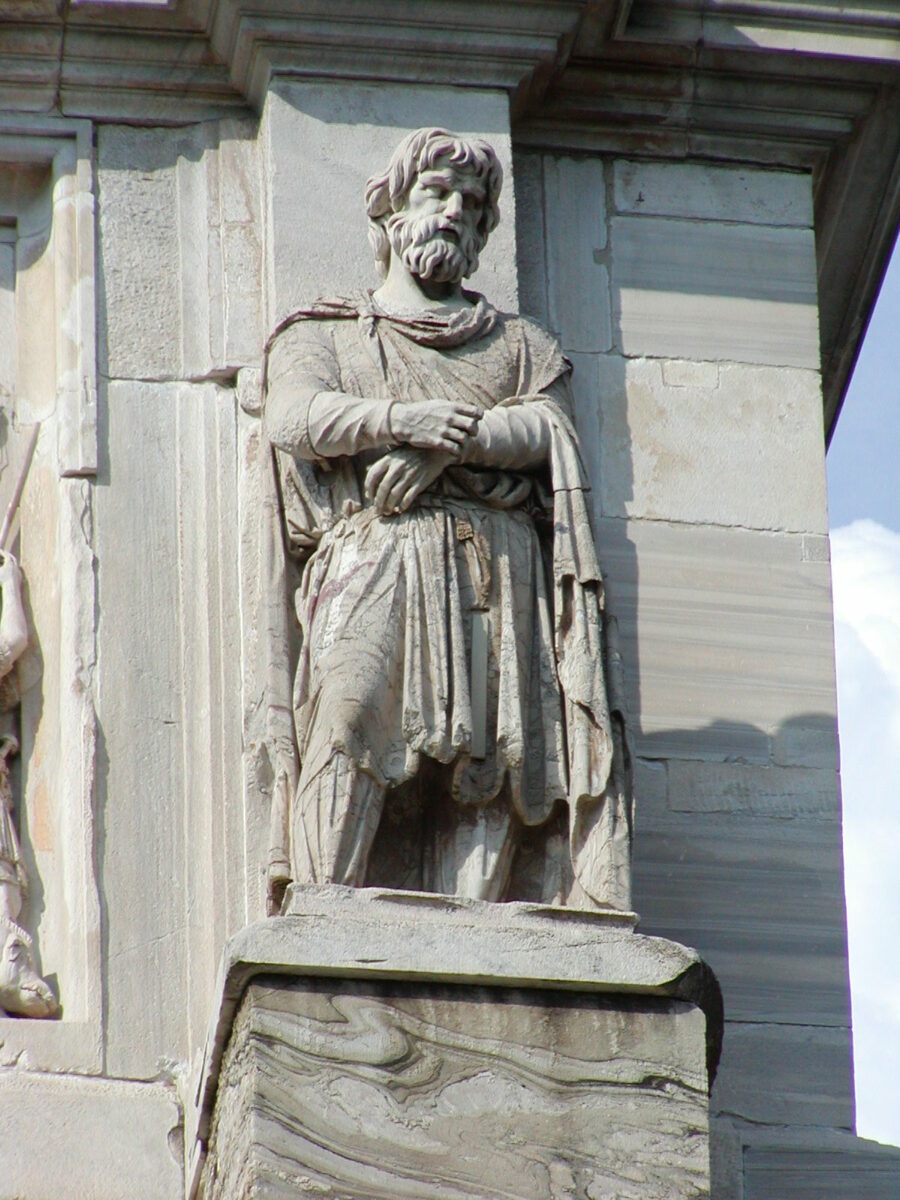
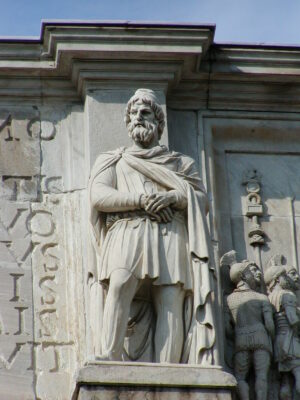
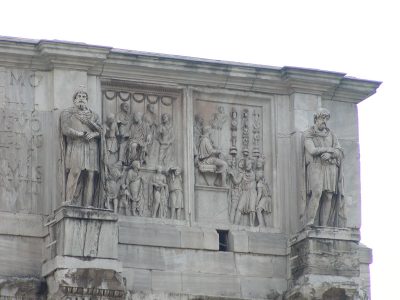
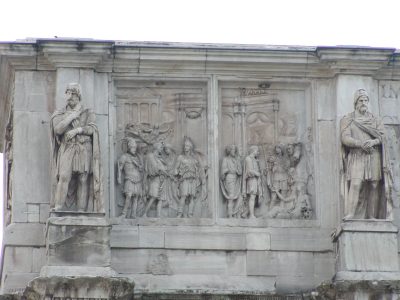
The oldest decorative parts of the arch are from the time of Trajan. The eight statues of pavonazzetto marble, depicting Dacian prisoners, placed above the Corinthian columns, are probably taken from the Forum of Trajan, since similar statues have been found there. One of these is a later replica in white marble. The rest have their hands and feet restored.
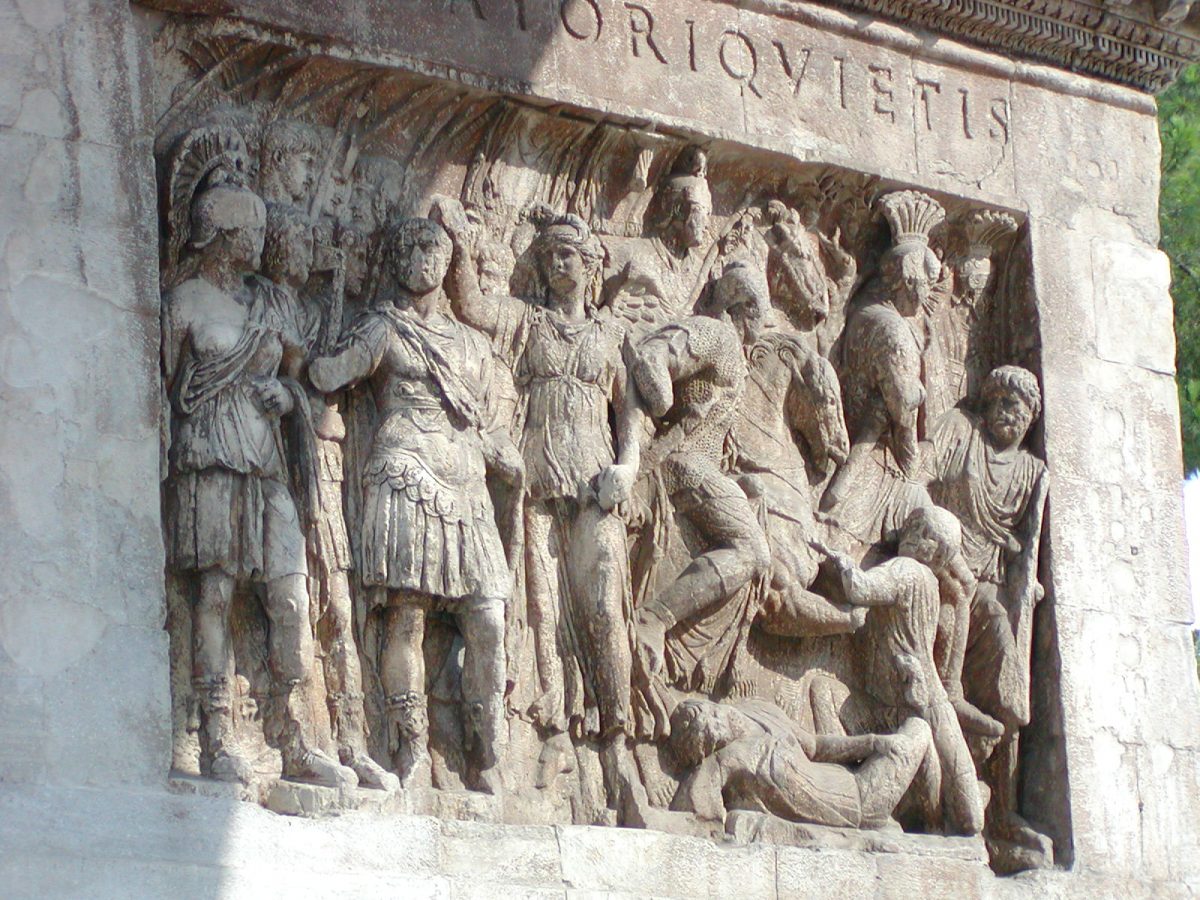
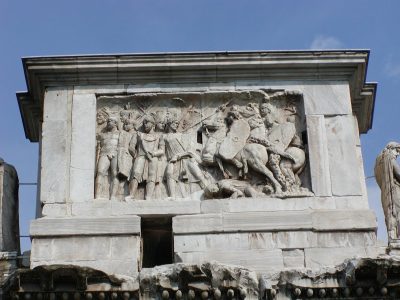
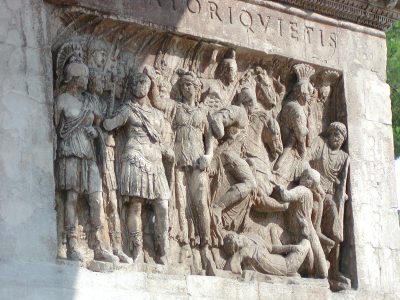
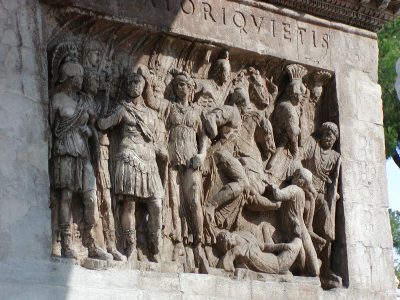
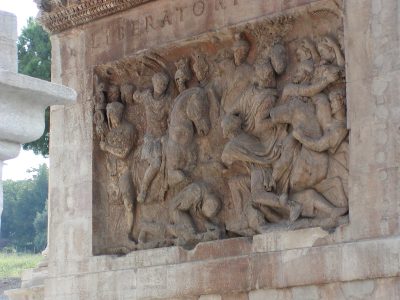
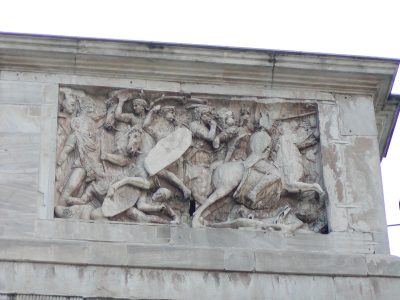
Also from the reign of Trajan are the large reliefs at the upper part of the ends of the arch, and the two reliefs on the inner walls of the central archway. The four reliefs are of the same dimensions and are all parts of the same larger series, measuring 3m×20m, which have probably been a part of the frieze of the Basilica Ulpia in the Forum of Trajan.
The order (left to right) of the four reliefs in the original frieze are: E. side of archway, E. end of monument, W. side of archway and W. end of monument. The reliefs show battle scenes, probably from the the Dacian wars during the reign of either Domitian or Trajan.
East side of arch 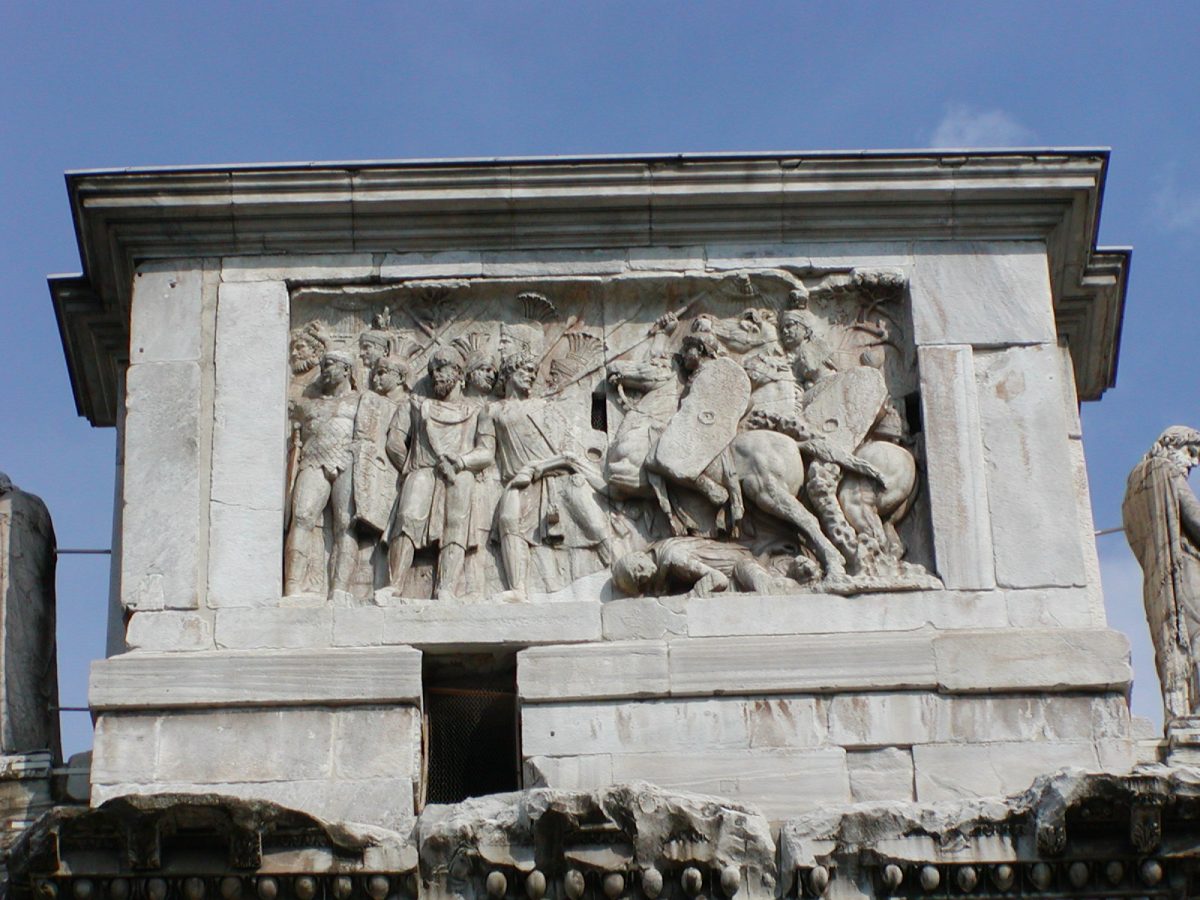
East side of monument 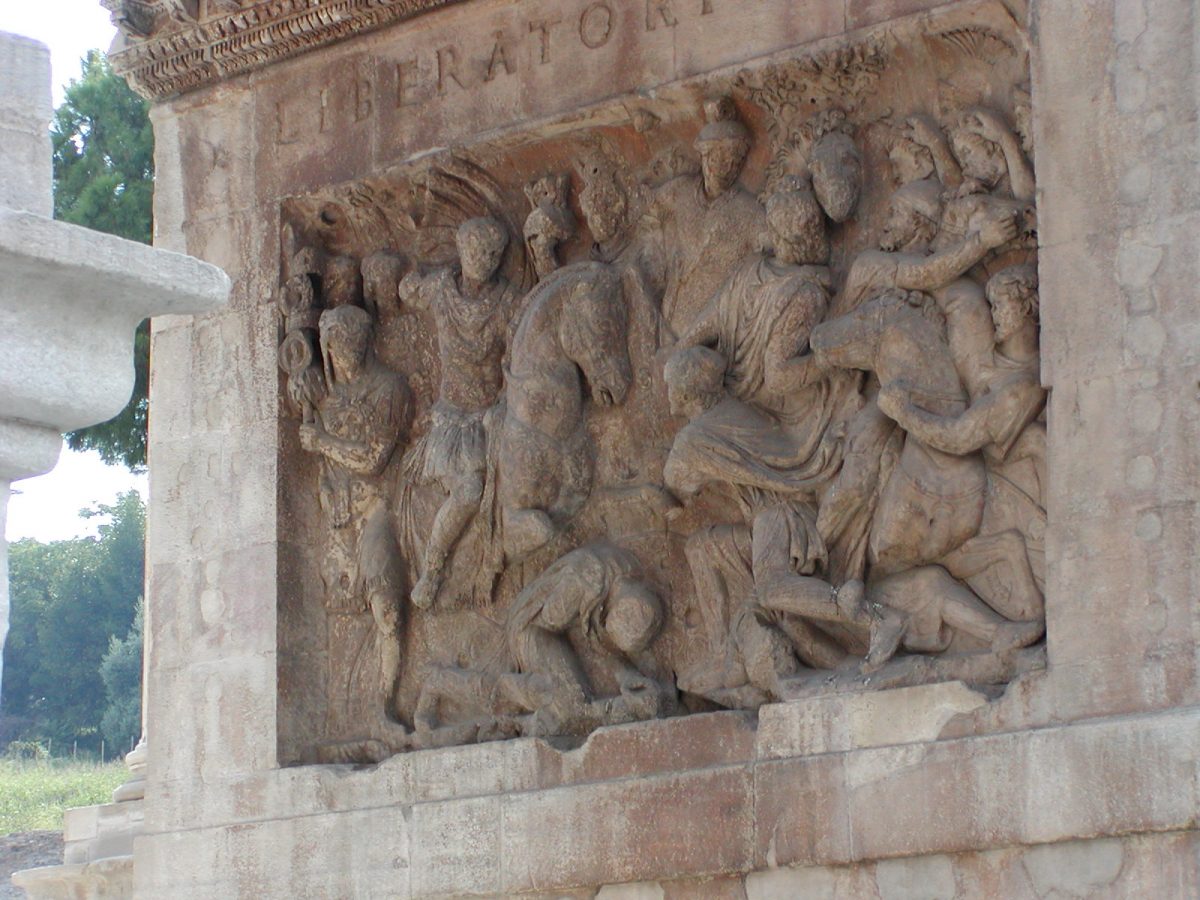
West side of archway 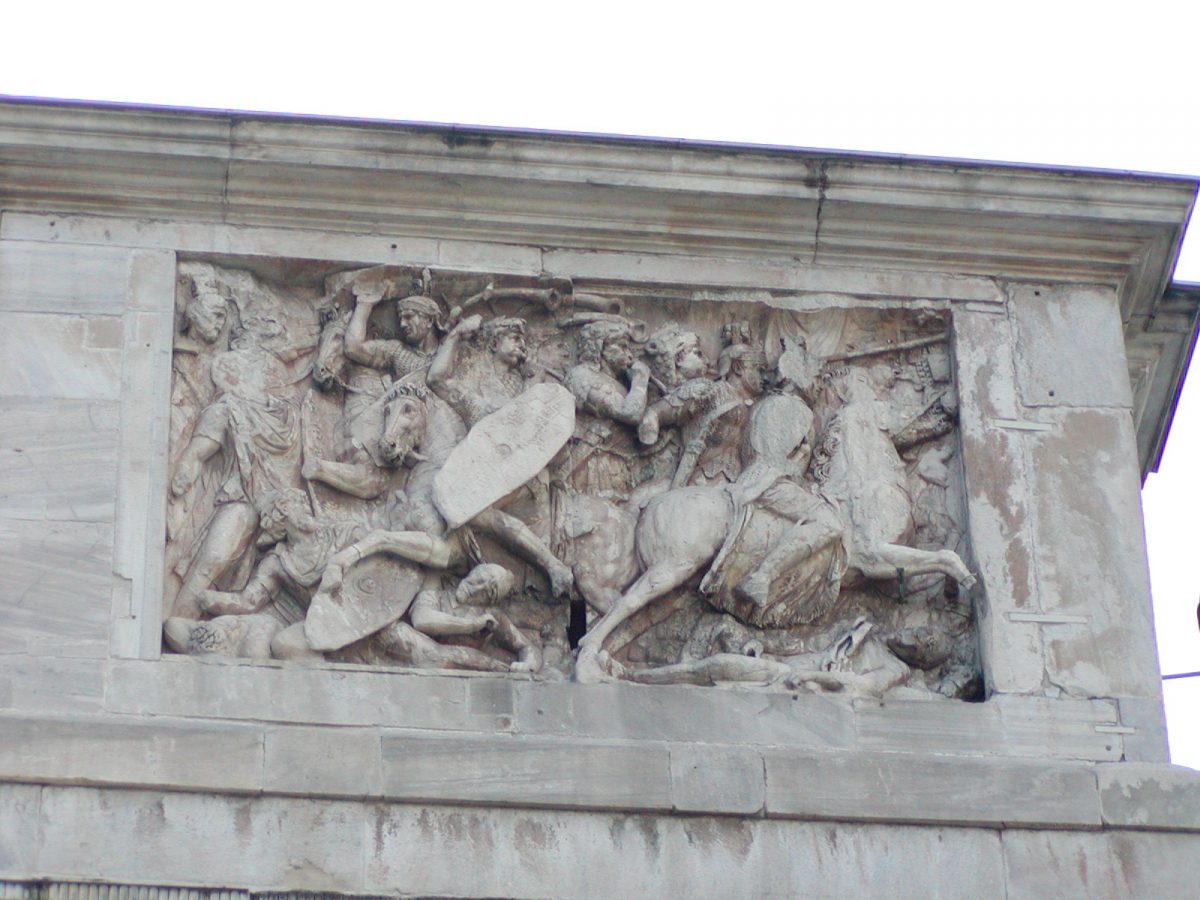
West side of monumnet
The Hadrianic Roundels
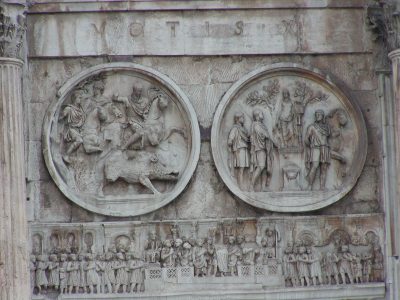
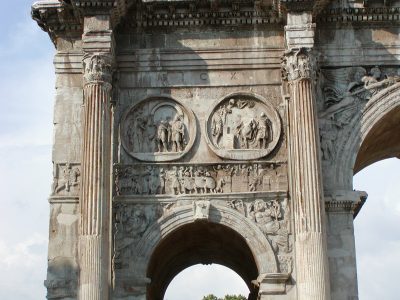
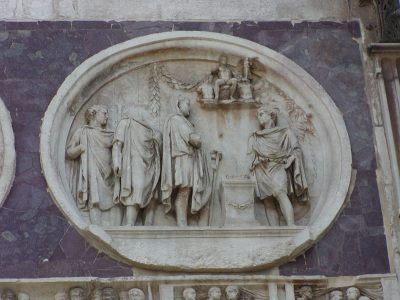
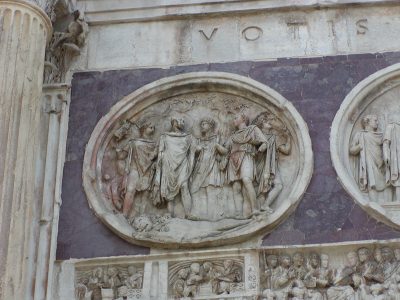
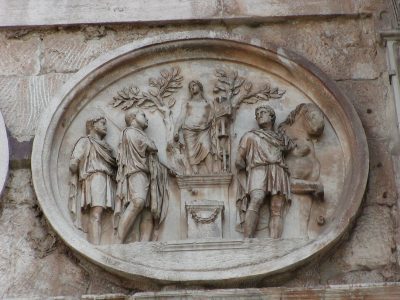
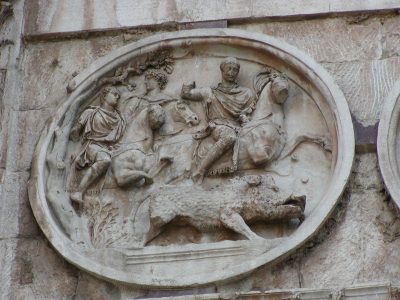
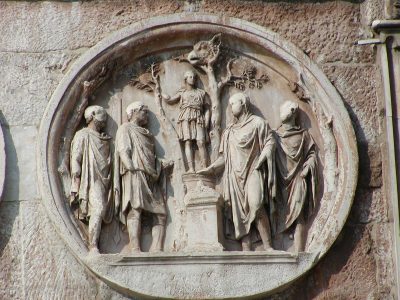
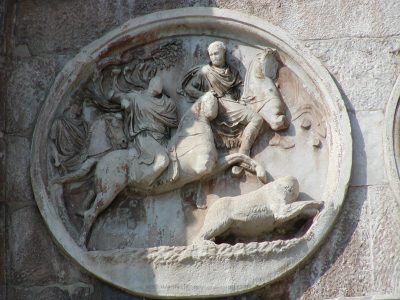
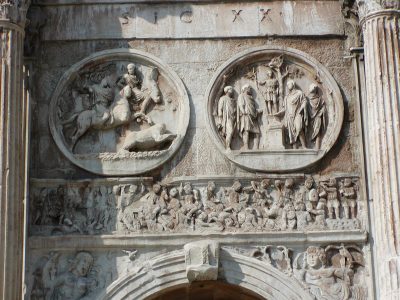
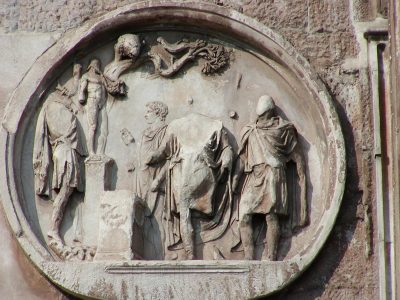
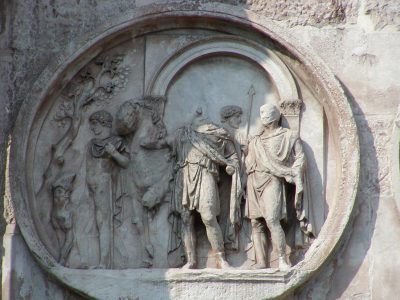
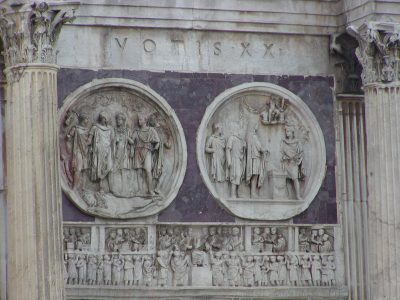
A series of eight roundels, each with a diameter of 2m, is located in pairs above the lateral archways. They have been dated to Hadrian‘s reign on stylistic reasons, and images of Hadrian and Antinous have been recognised in them.
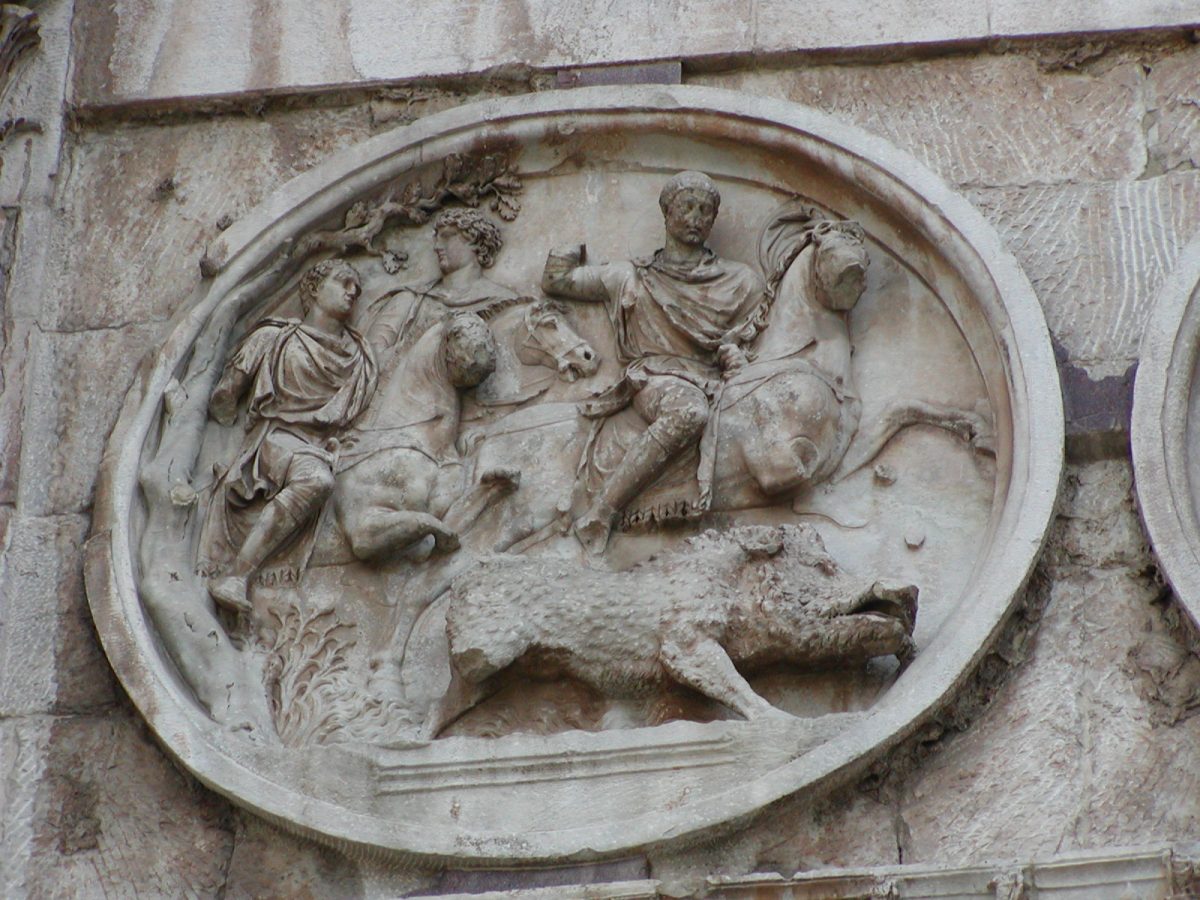
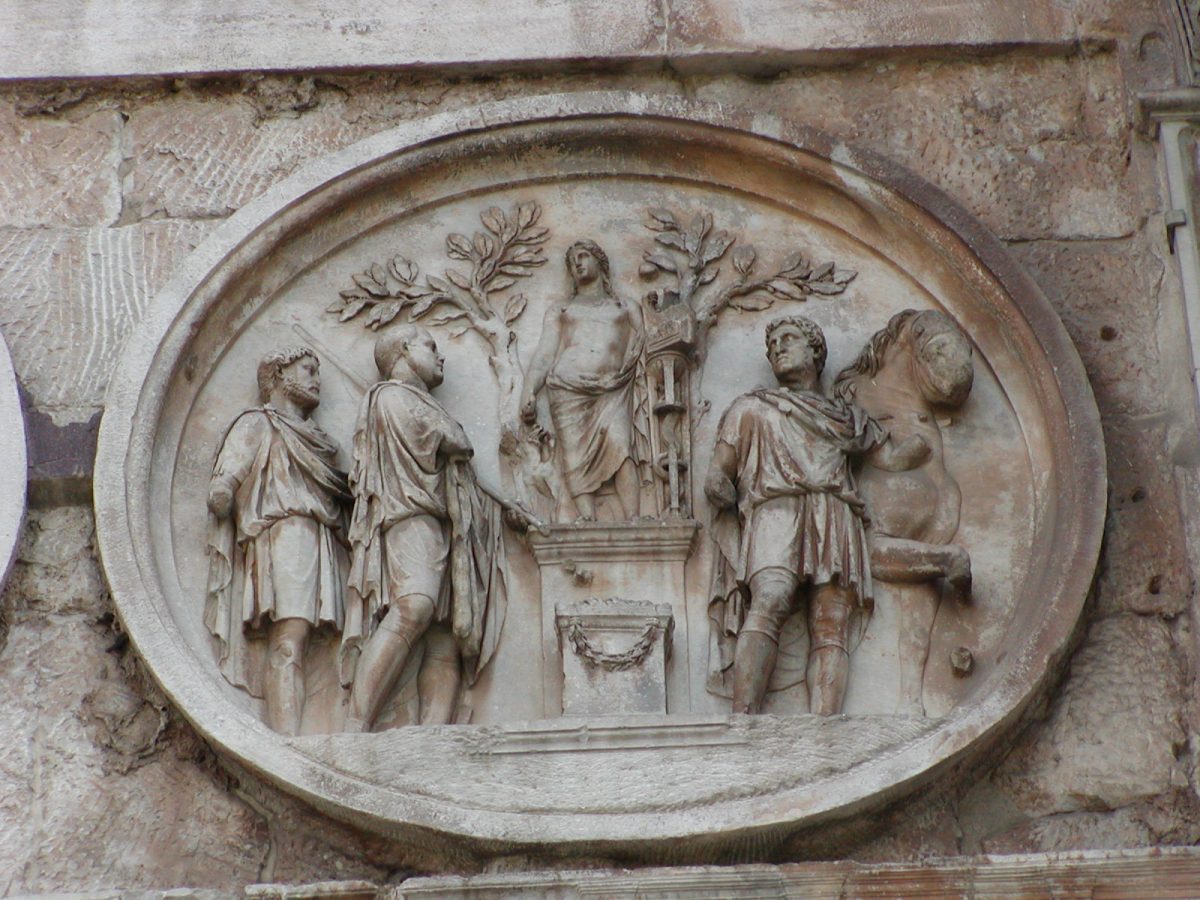
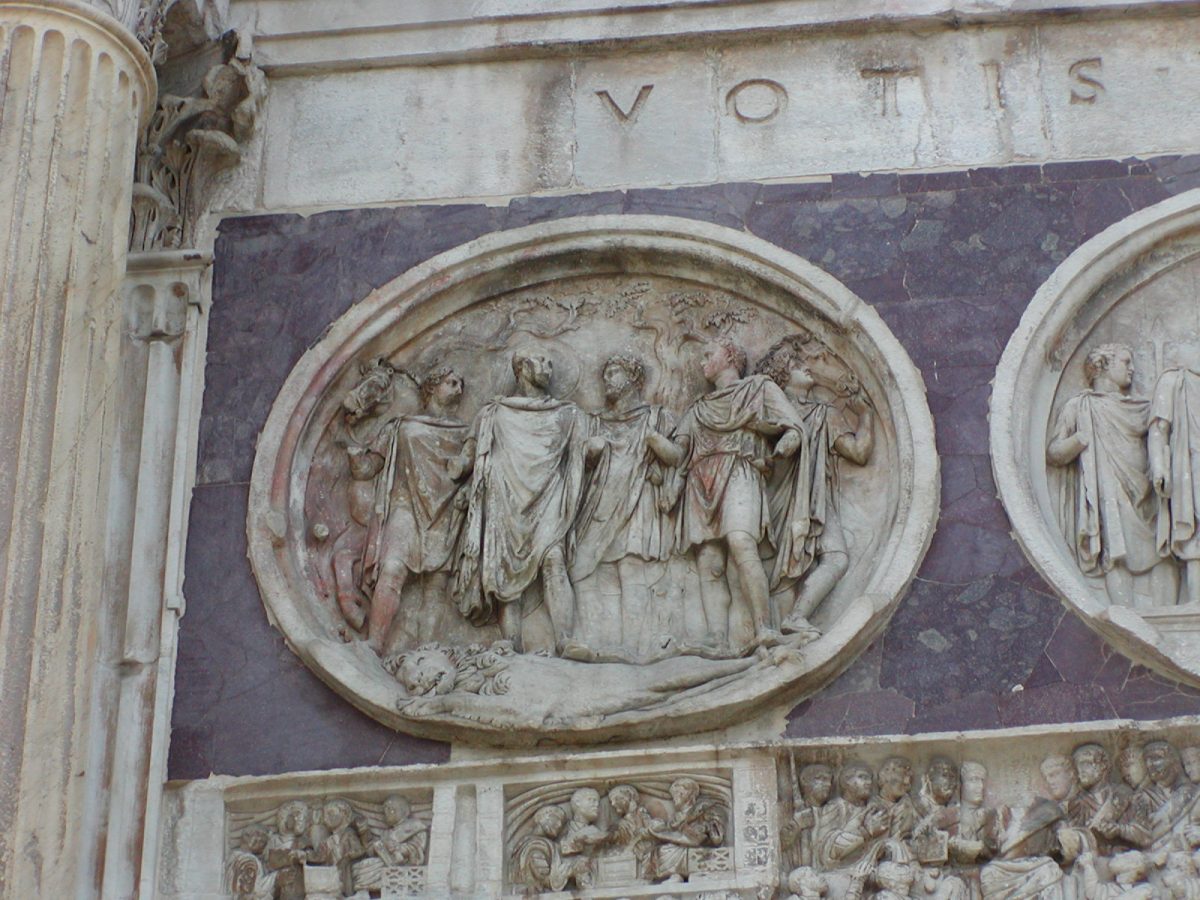
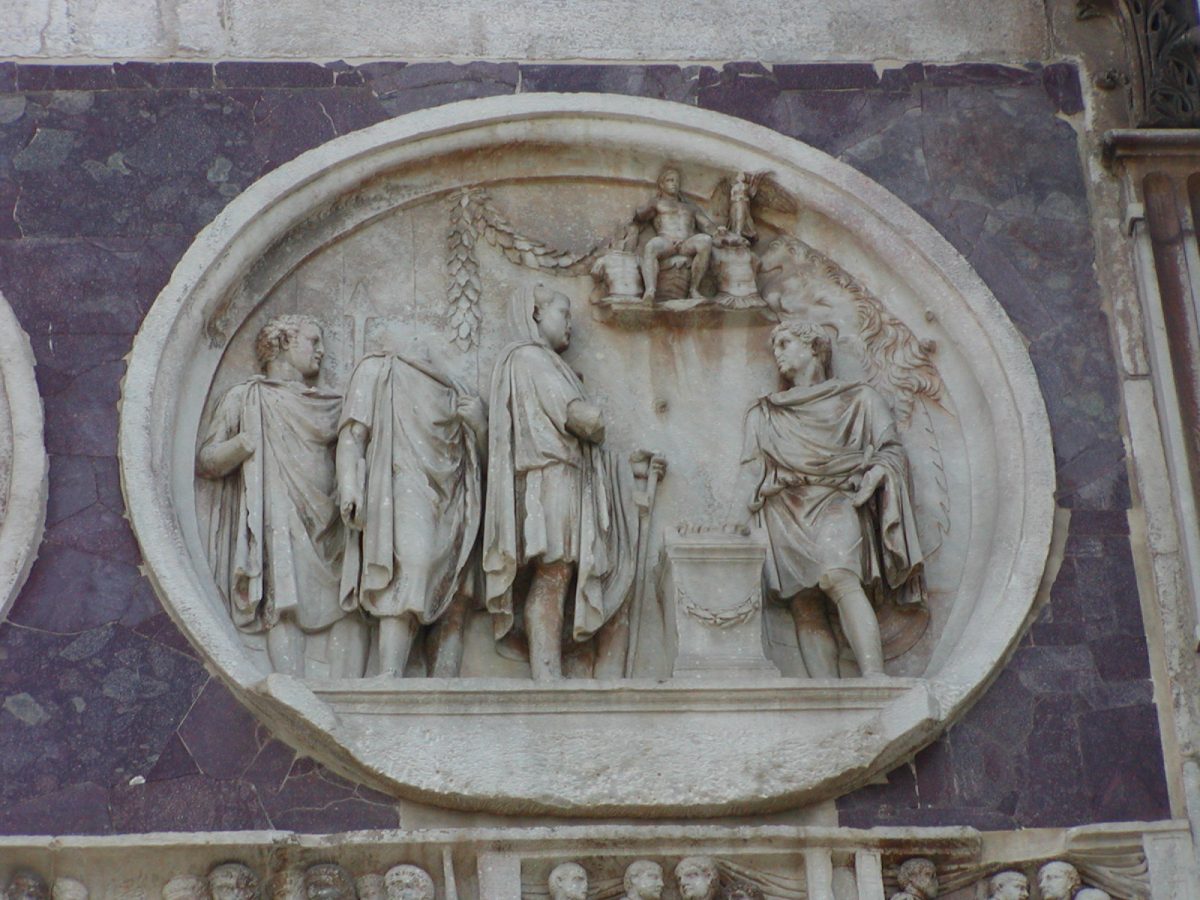
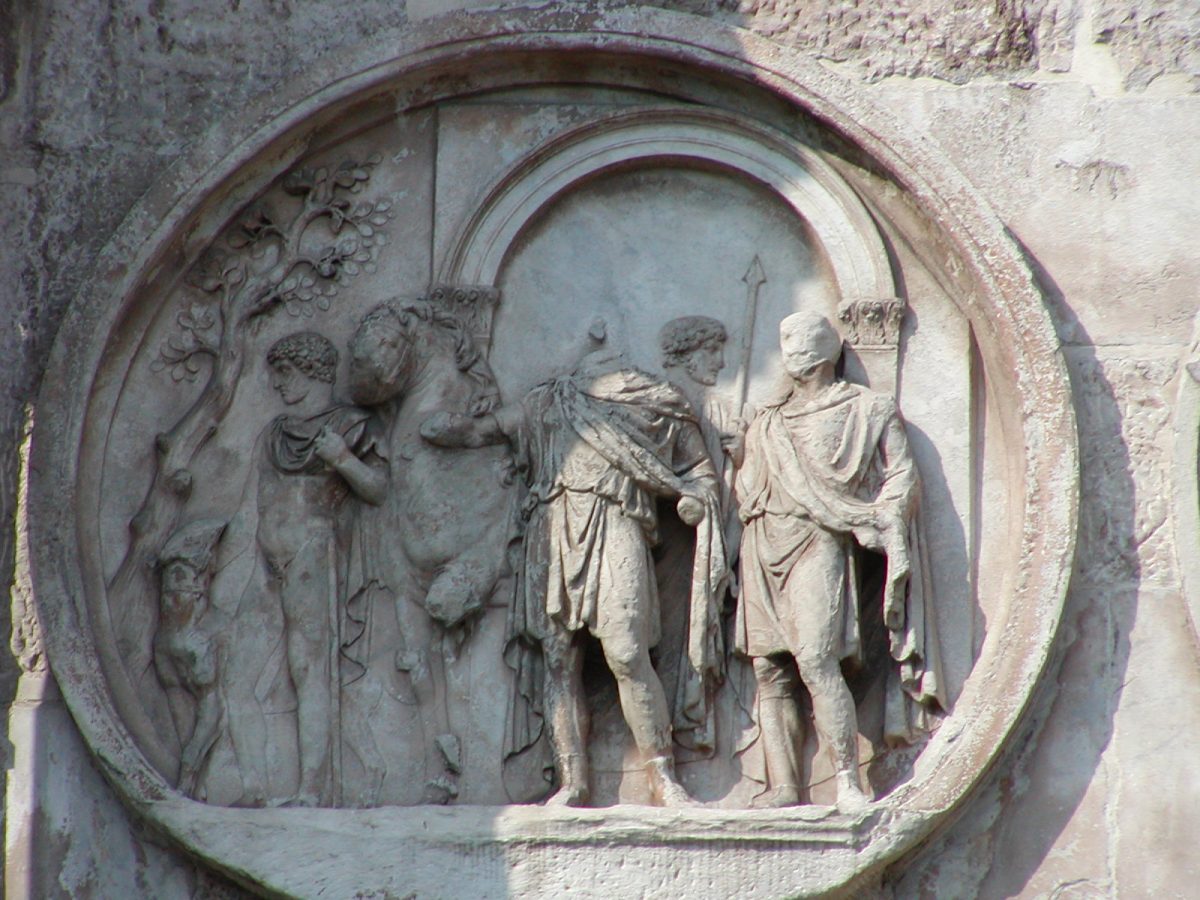
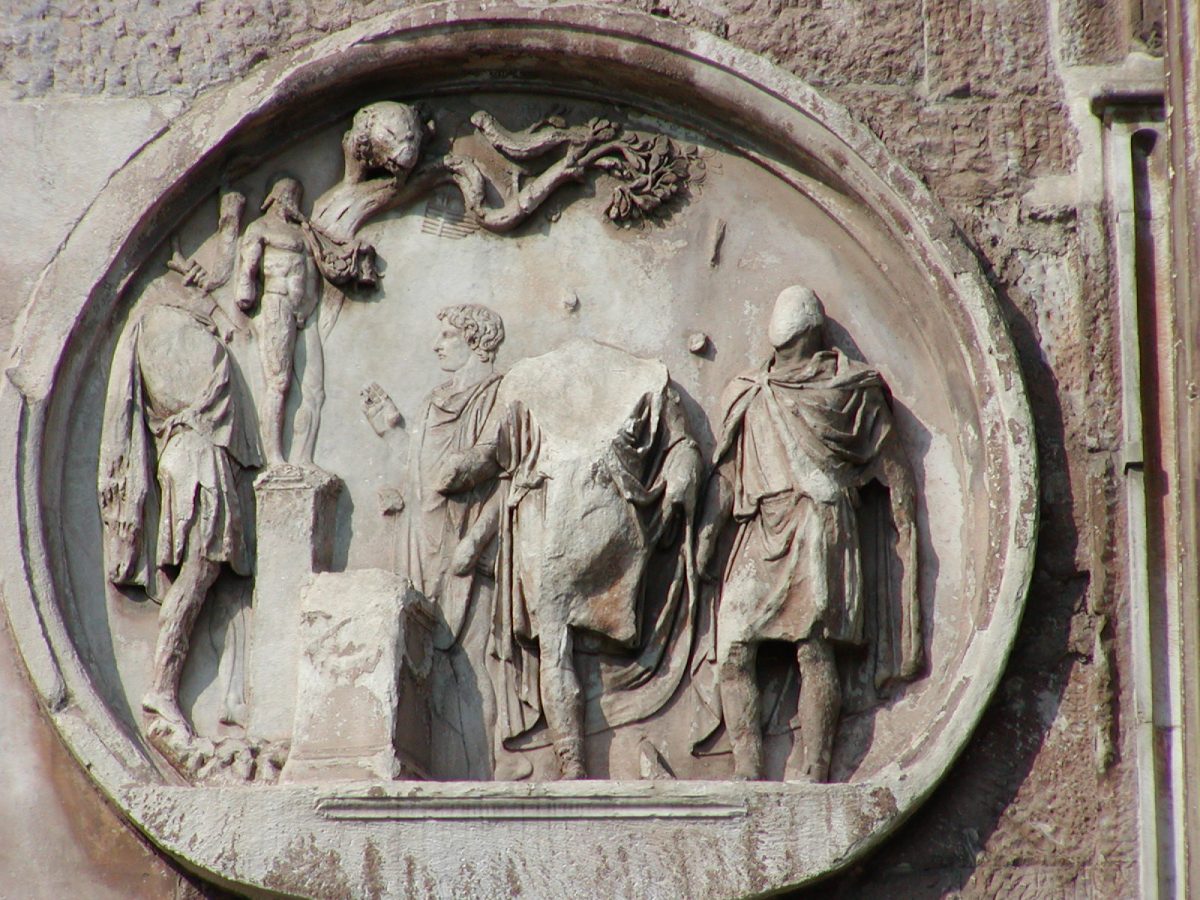
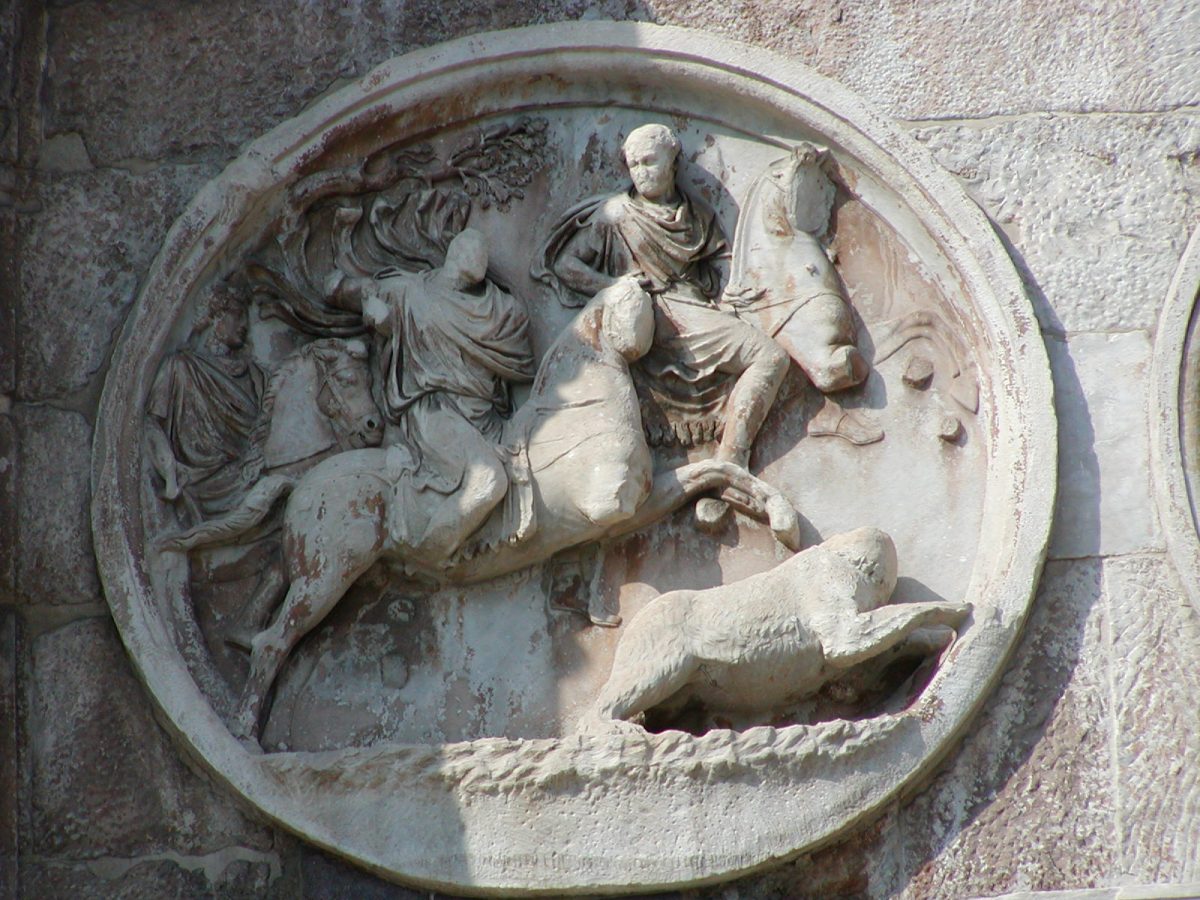
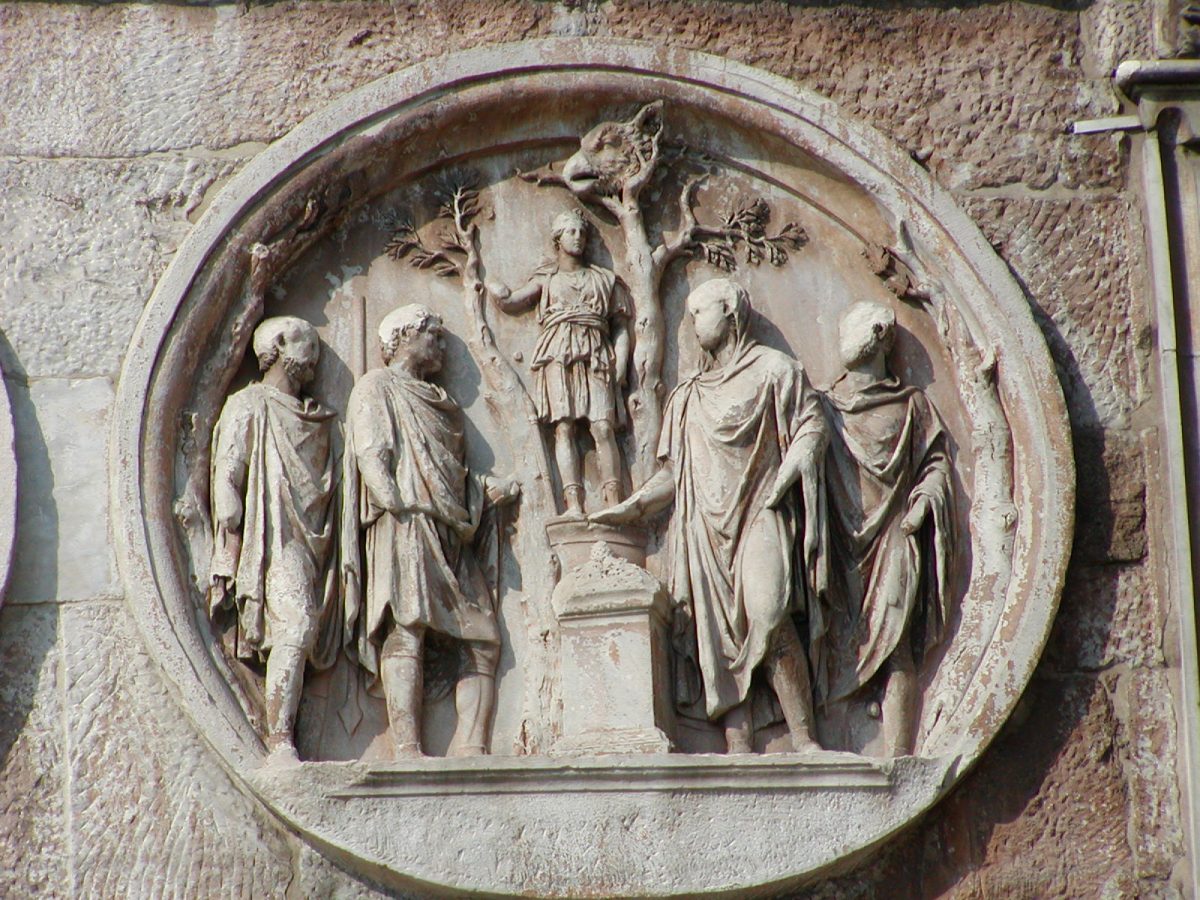
The scenes on the roundels are all related to hunting or sacrifice, probably to be interpreted as metaphors for the military and religious roles of the emperor. On the N. face of the arch the roundels show (left to right) the hunt for wild boar; a sacrifice to Apollo; the hunt for lion; and a sacrifice to Hercules. The roundels on the S. face show the departure for the hunt; a sacrifice to Silvanus; the hunt for bear; and a sacrifice to Diana.
Some roundels have been modified. The central figure on all eight roundels, which originally portrayed Hadrian, has been changed to depict Constantine, while other recognisable figures from Hadrian’s entourage, such as Antoninus Pius, the adopted heir, and Antinous, Hadrian’s young favourite, remain unchanged. Besides this, the roundel showing a lion hunt (N. face, 2nd. from the right) has been changed further.
All eight roundels have an undecorated baseline on which the figures stand, but this baseline has been re-carved into a slain lion that is not a part of the original composition. On this roundel Antoninus Pius is in the middle background, while Antinous is holding a horse on the extreme right.
The roundels could be from some unknown Hadrianic monument, but unlike other reused elements on the arch they do not appear to have been remounted in a new context.
Originally the roundels were set in a panel of porphyry slabs, but these has since been removed, except on the right side of the N. face.
The Reliefs of Marcus Aurelius
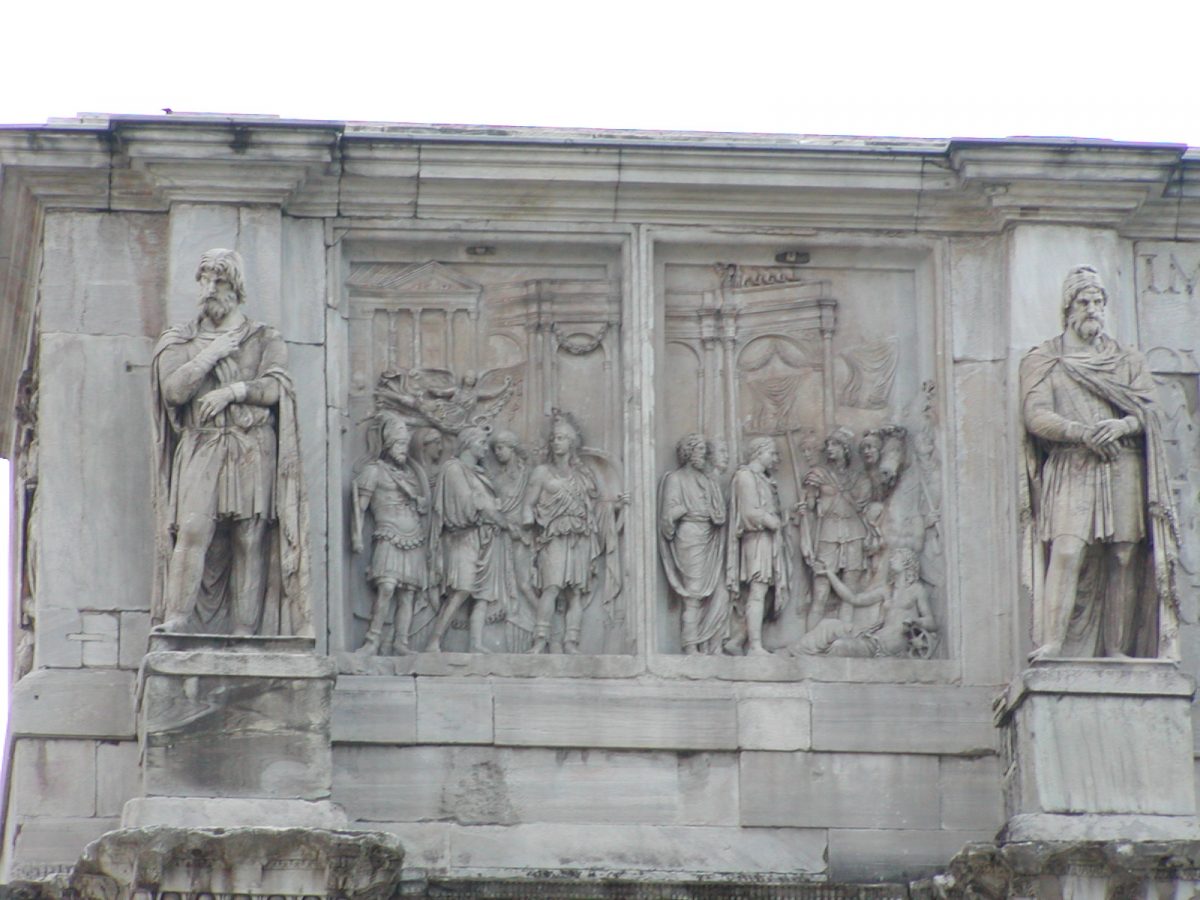
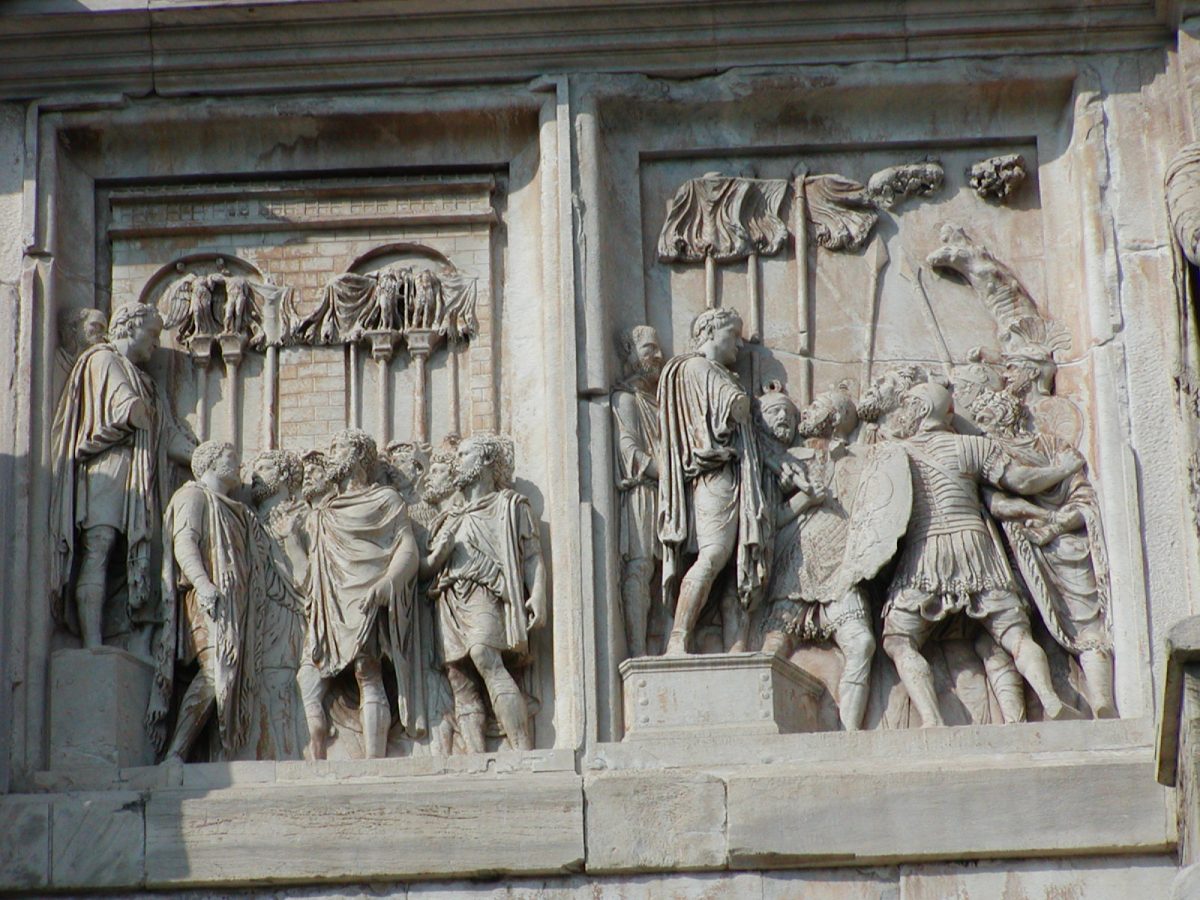
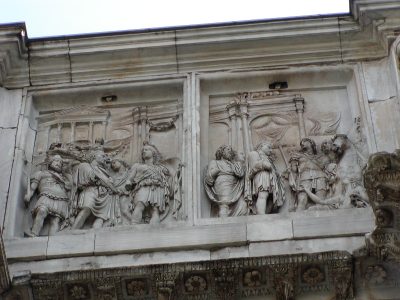
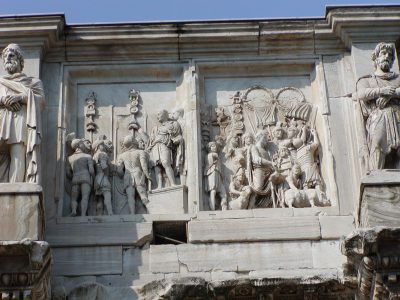
On the attic, above each of the lateral archways and on each side of the central inscription, are eight panels mounted in pairs.
They are from the time of Marcus Aurelius or his son Commodus, but the provenance of the reliefs is unknown. It is, however, likely they come from one of two now lost triumphal arches erected by Commodus in honour of his deified father Marcus Aurelius.
The reliefs are contemporary with the Column of Marcus Aurelius and have the same motif: the wars against the invading Germanic tribes known as the Marcomanni and the Quadi.
North face, left 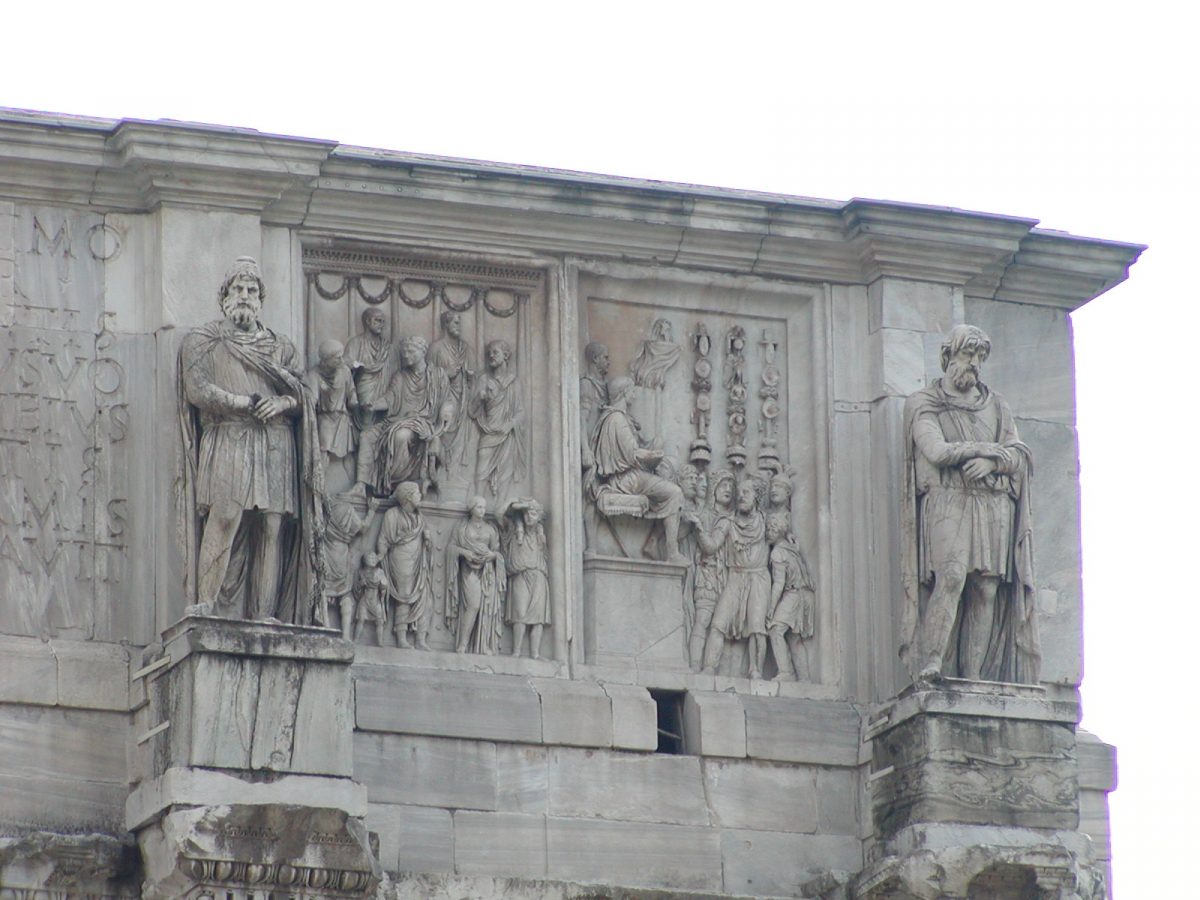
North face, right
On the N. face of the arch the motives are (left to right): the emperor entering Rome after the campaign (the adventus), in the background are the Temple of Fortuna and the Triumphal Gate, both located along the route of the triumphal processions; the emperor leaving Rome for the campaign (the profectio), again with the Triumphal Gate in the background; the emperor distributing money to the people, the building in the background is probably the Basilica Ulpia; and an enemy chieftain surrendering to the emperor.
South face, left 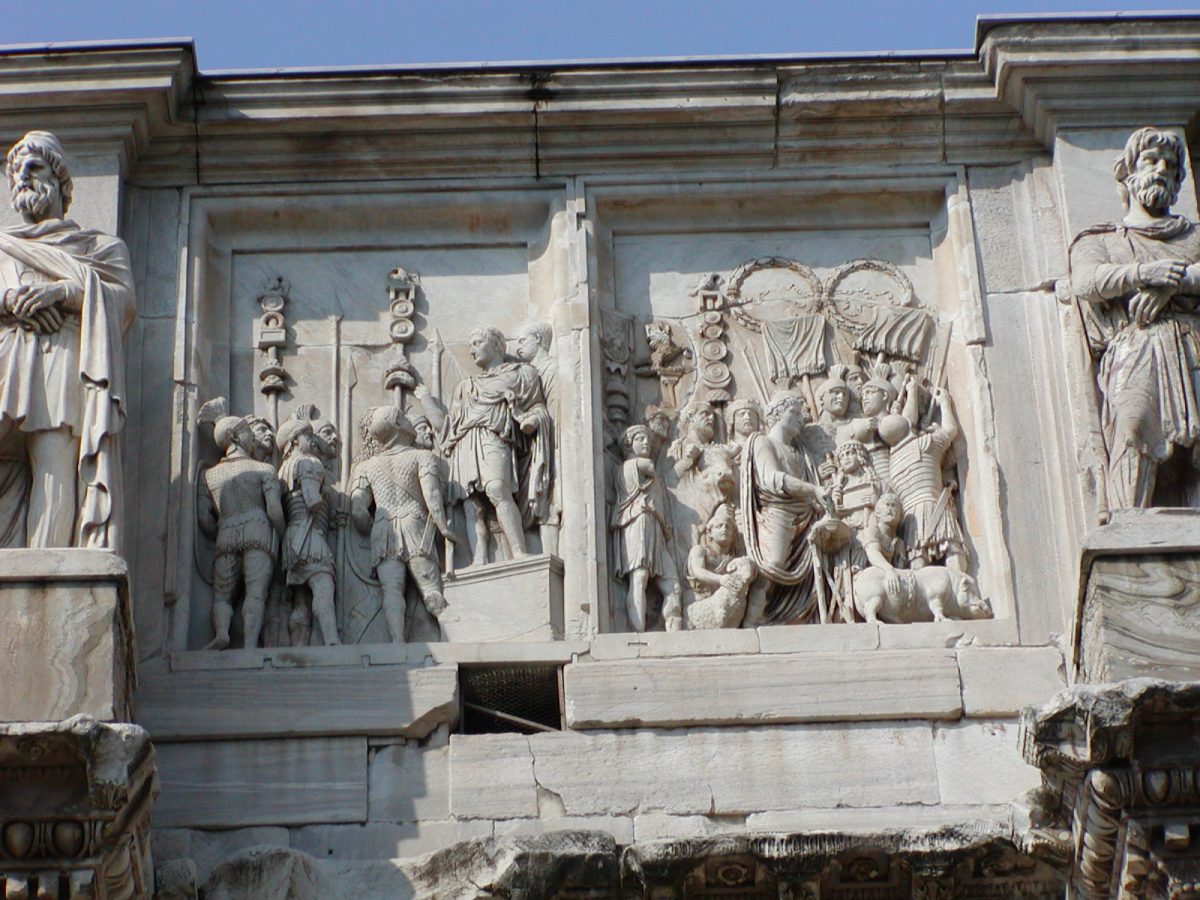
South face, right
On the S. face the motives are (left to right): the presentation of a captured enemy chieftain to the emperor; enemy prisoners being led to the emperor; the emperor talking to the soldiers before the battle (the adlocutio); and scenes of sacrifice on the battlefield of a bull, a pig and a sheep.
Constantinian Art on the Arch
The rest of the decorative elements are from the time of Constantine I. The most important are the inscription and the long narrative frieze that encircles the entire arch.
The Inscription
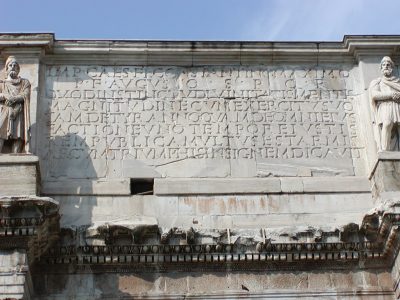
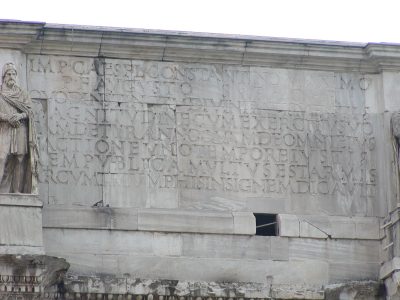
The central inscription is repeated on both sides of the attic. Only the holes in which the original bronze letters were mounted are preserved, but the text is easily readable:
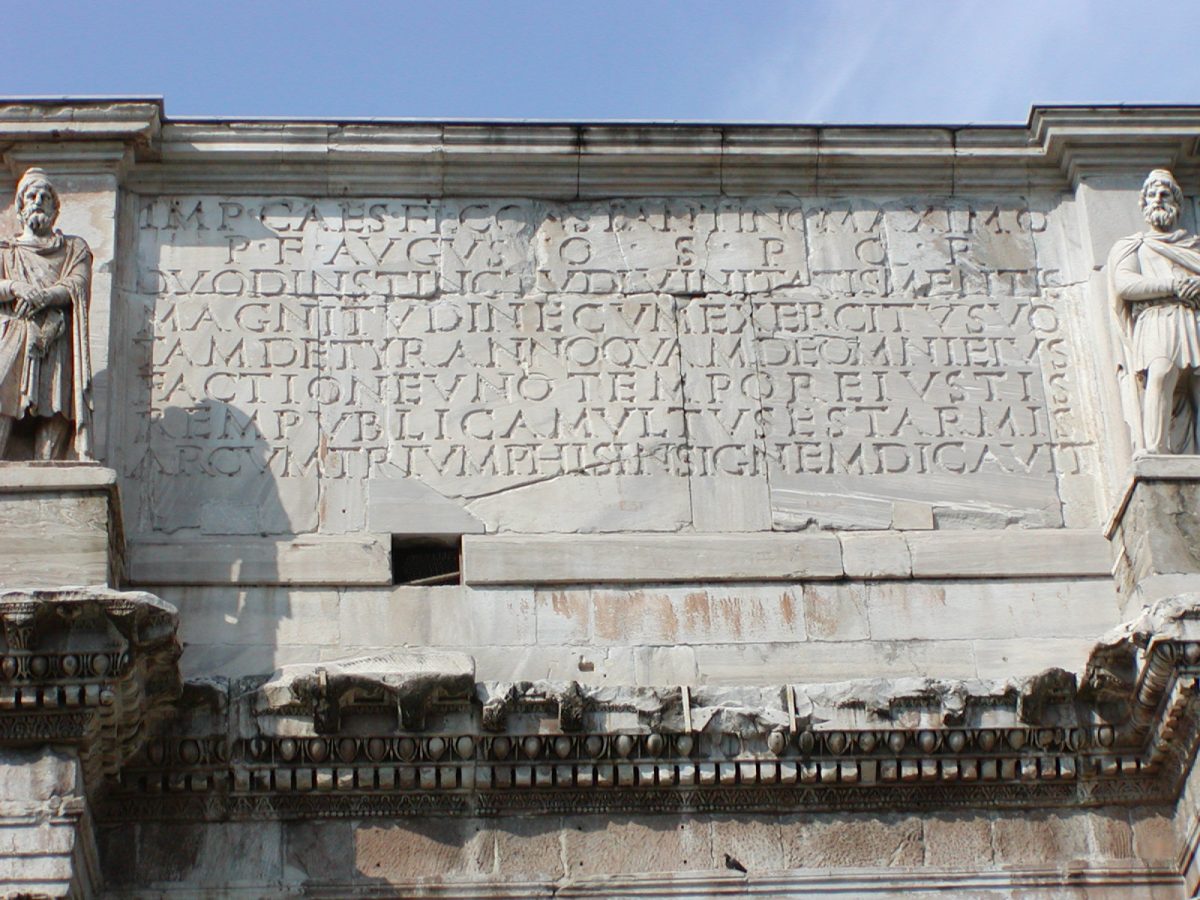
Imp(eratori) Caes(ari) Fl(avio) Constantino Maximo
P(io) F(elici) Augusto S(enatus) P(opulus)q(ue) R(omanus)
quod instinctu divinitatis, mentis
magnitudine, cum exercitu suo
tam de tyranno quam de omni eius
factione uno tempore iustis
rempublicam ultus est armis,
arcum triumphis insignem dicavit.
To the emperor Caesar Flavius Constantine Maximus,
Pius Felix Augustus,
since through divine inspiration and great wisdom
he has delivered the state
from the tyrant and all his factions,
by his army and noble arms,
the Senate and the Roman People,
dedicate this arch decorated with triumphal insignia.
The tyrant mentioned is Maxentius and the battle is that of the Milvian Bridge. The most debated part of the inscription is the words instinctu divinitatis, “by divine inspiration”, which has been seen as a reference to the famous vision Constantine is said to have had just before the battle.
The Main Frieze
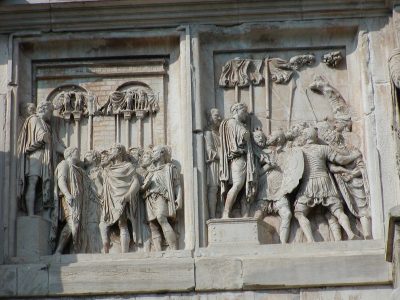
The main contribution to the decoration of the arch from the time of Constantine is the almost continuous frieze located just above the lateral archways and at the same height on the ends of the monument. Each part of the frieze measures c. 1m in height and between 5.5-6.5m in length.
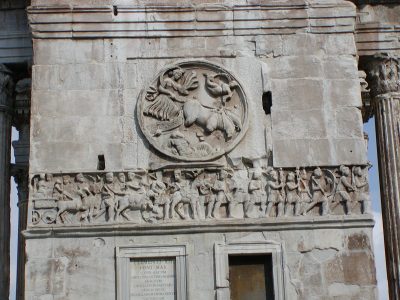
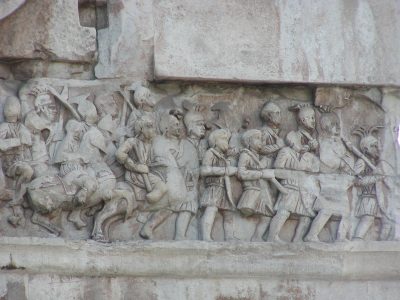
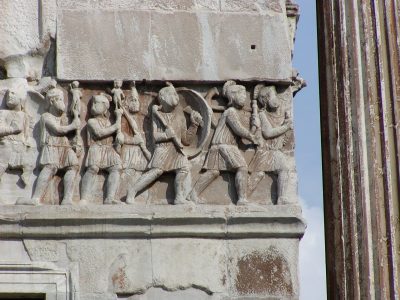
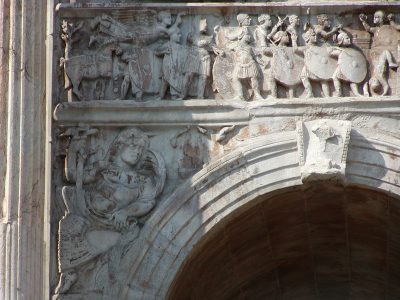
The narrative starts on the W. side (towards the Palatine Hill) where Constantine and his army leaves Mediolanum (Milan). The soldiers are marching towards the right (where the narrative continues around the corner) with their gear loaded on carts and horses. The emperor does not appear on the relief.
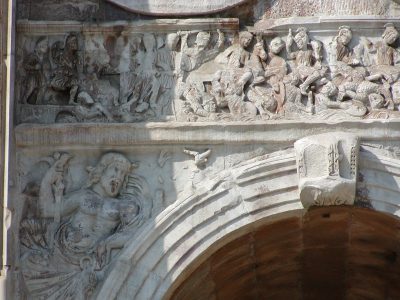
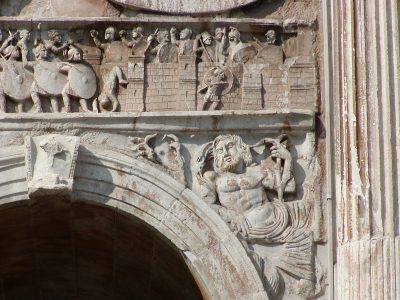
The frieze continues on the S. face, where the siege of Verona is depicted to the left. Constantine’s soldiers have dismounted their horses and spurred on by Victoria above them, they attack the fortified city to the left in the relief. The defenders on the walls are throwing rocks at the attackers, and one has been hit and is falling from the wall. The emperor does not take part in the fighting.
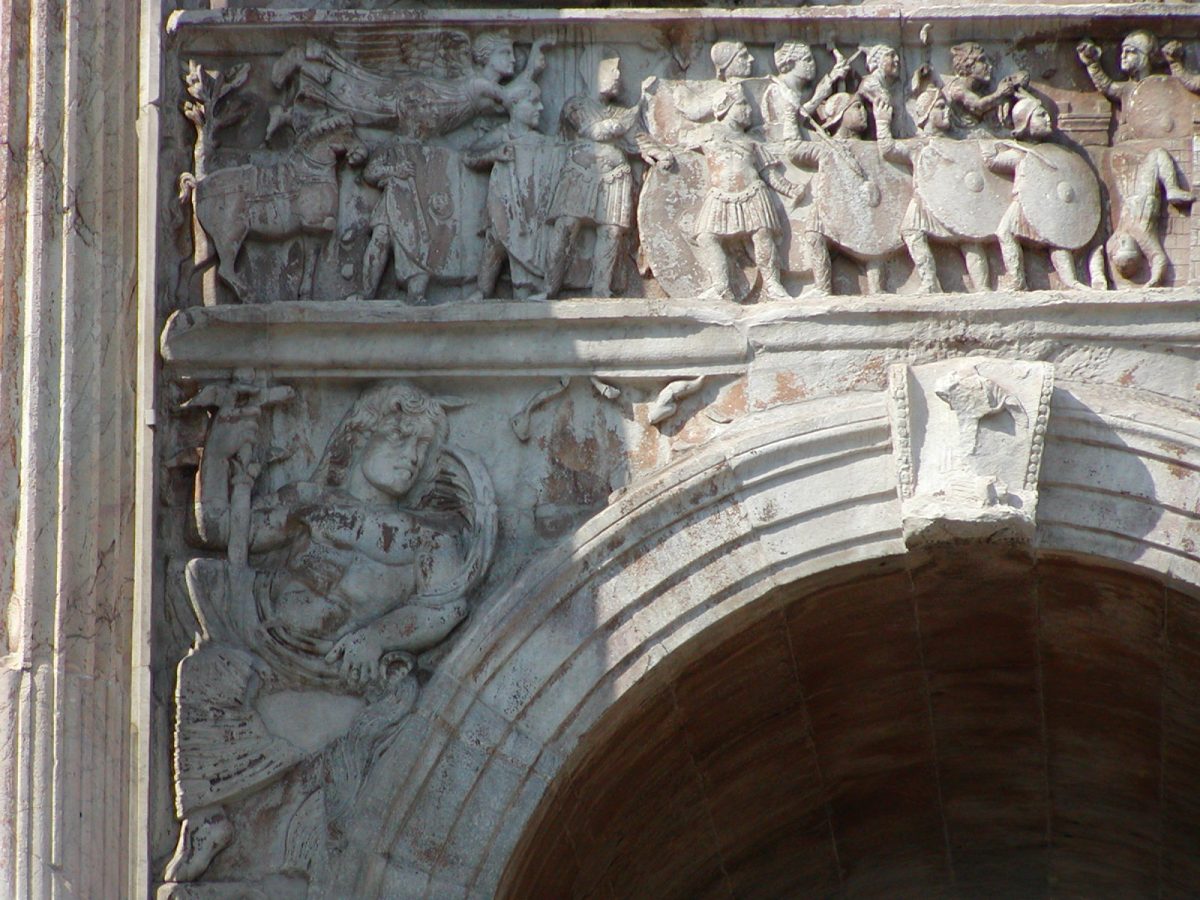
Main frieze, south side, left 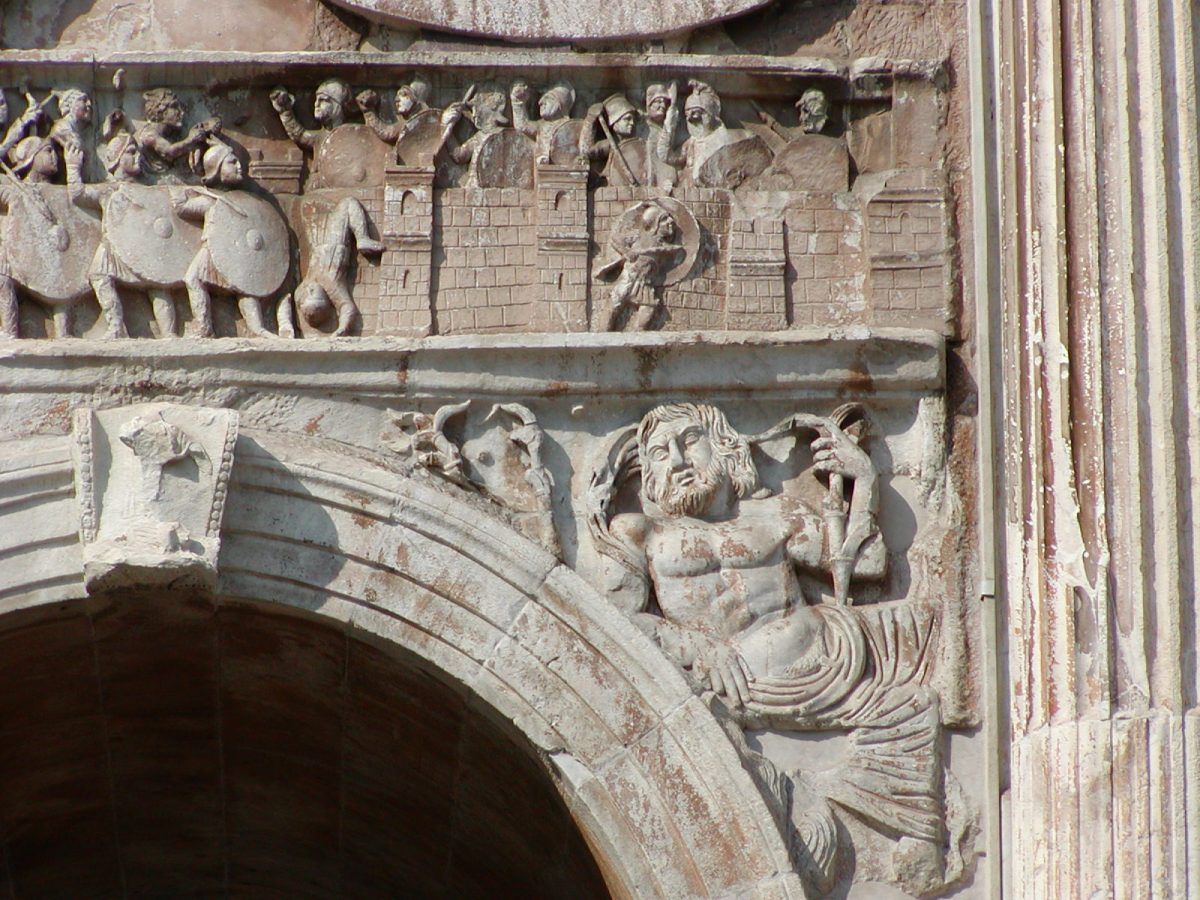
Main frieze, south side, left
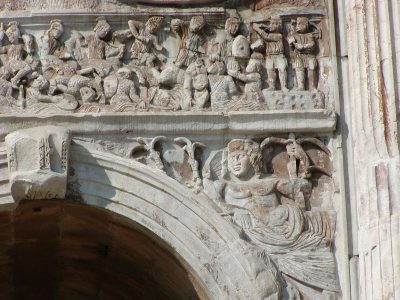
On the right side of the S. face the battle of the Milvian Bridge is illustrated. Part of the battle took place on the bridge and on a temporary bridge made of small boats. The relief shows the bridge from the side.
The soldiers of Constantine are on the bridge while Maxentius‘ troops are fighting for the lives in the water under the bridge. To the left a missing figure could be Constantine overlooking the battle.
On the opposite side of the river trumpeters are signalling retreat to the loosing forces of Maxentius.
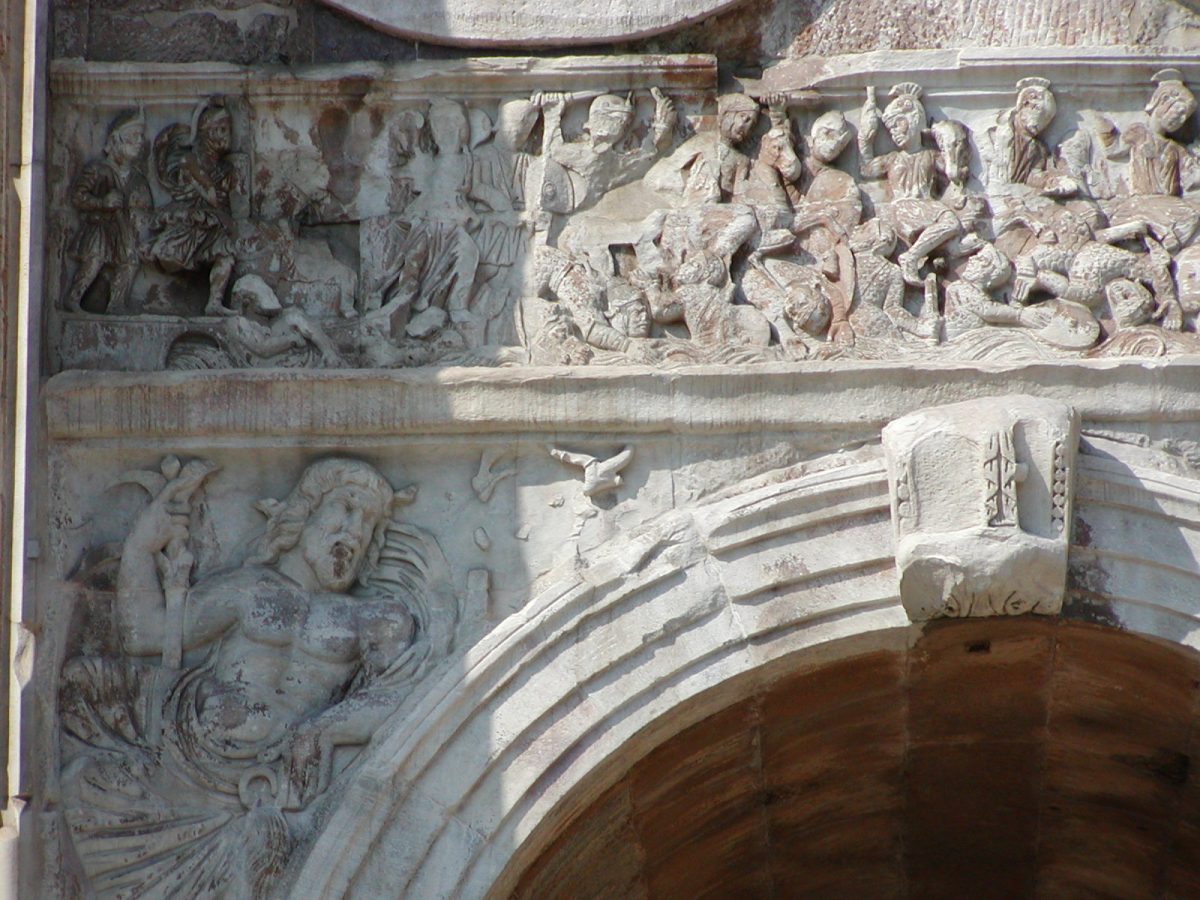
Main frieze, south side, right 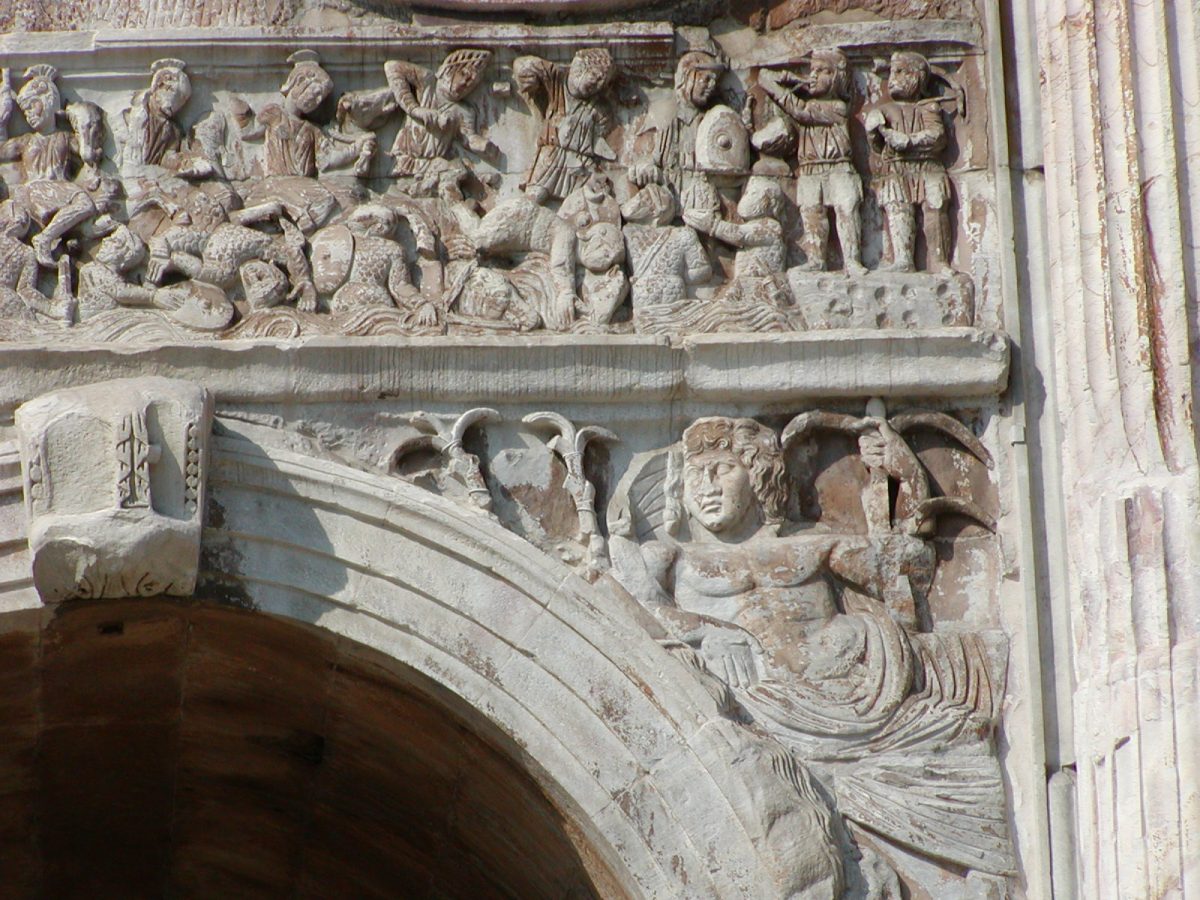
Main frieze, south side, right
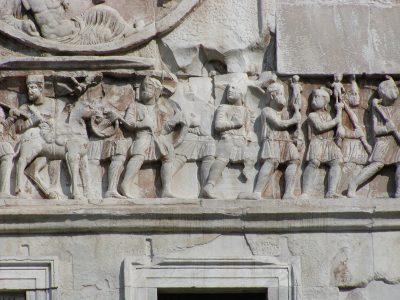
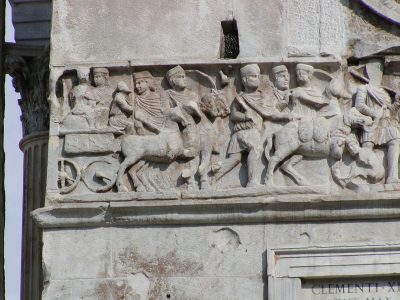
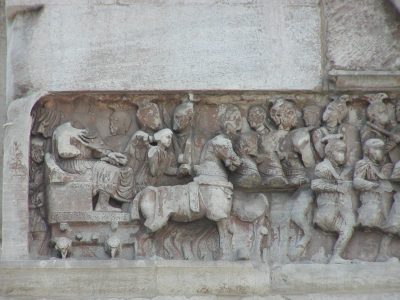
On the E. side of the arch (towards the Colosseum) Constantine and his soldiers enter Rome triumphantly after the victory at the Milvian Bridge, Constantine riding a quadriga (a four-horse chariot) to the extreme left with his army marching in front of him with a group of prisoners.
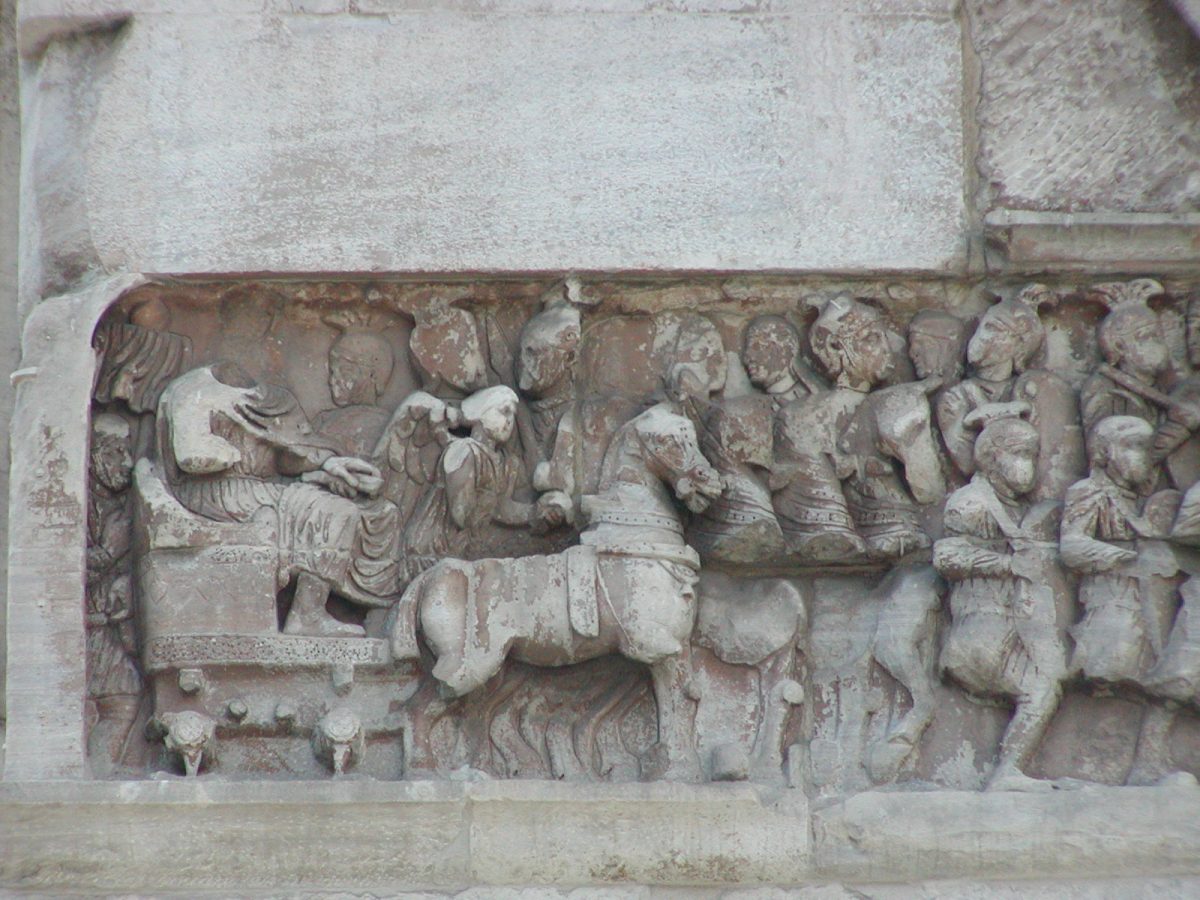
Main frieze, east side 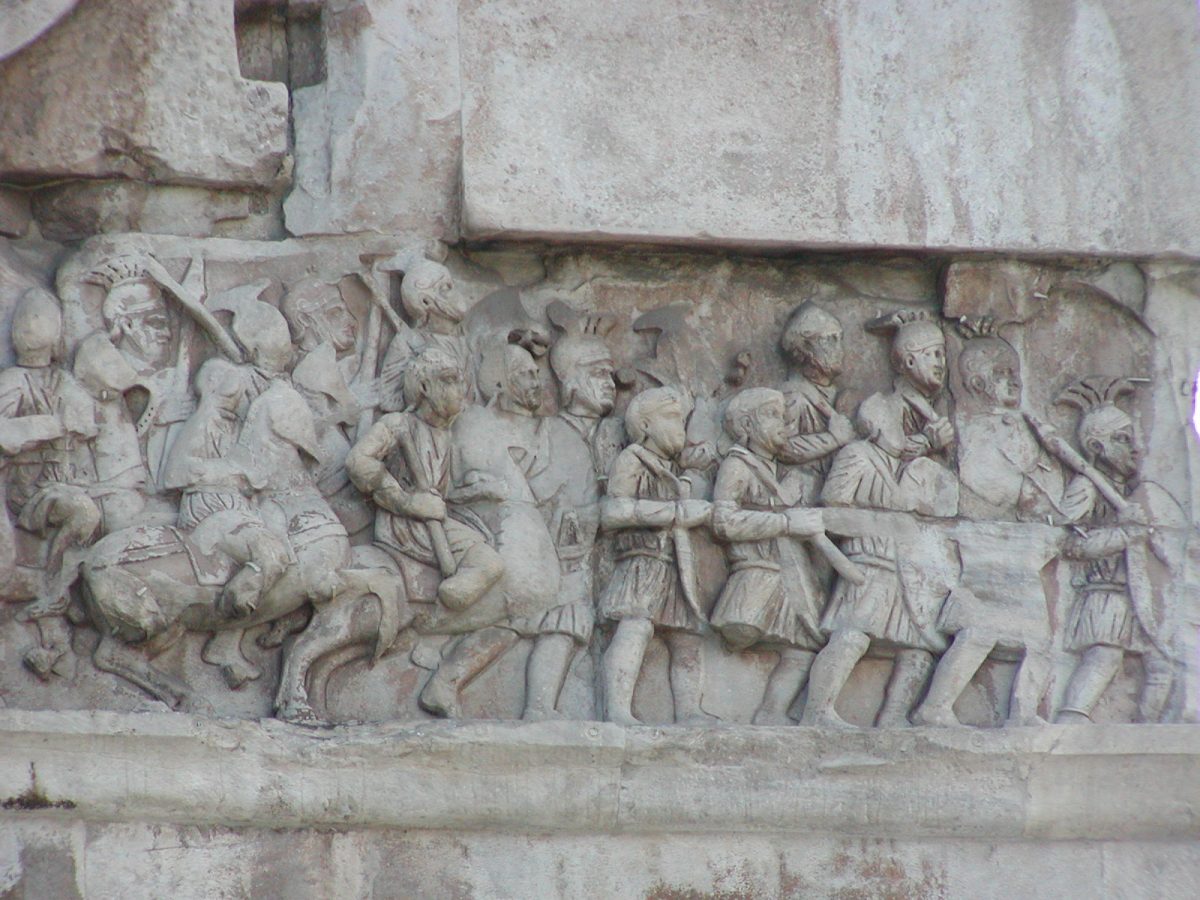
Main frieze, east side
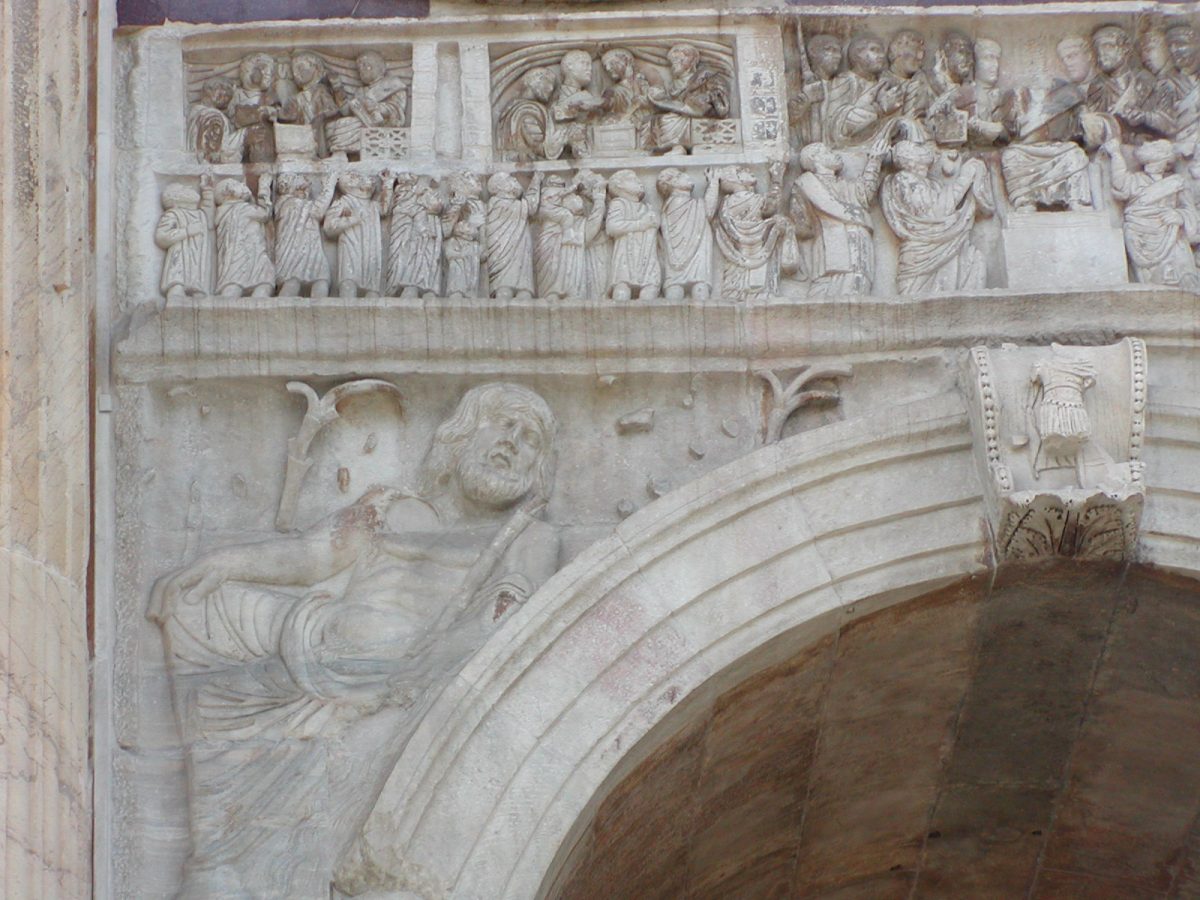
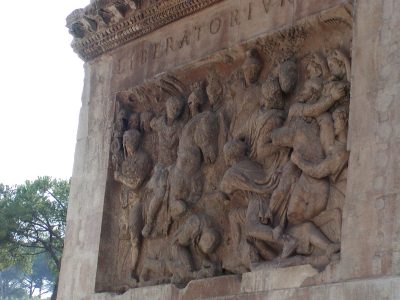
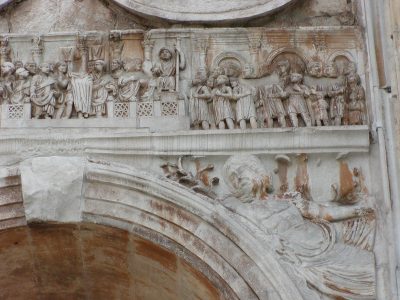
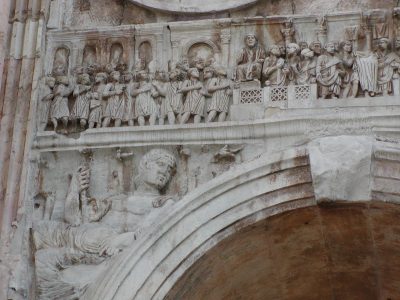
The N. face of the arch shows the final ceremonies of the triumph. First, on the left, Constantine addresses the people from the rostra, the speakers platform on the Forum Romanum. Constantine is standing on the platform in the centre (his head has been knocked off), surrounded by his generals.
The rostra is decorated with honorary columns and two seated statues of former emperors, probably Hadrian and Marcus Aurelius. To the right, behind the listening crowd, is the Arch of Septimius Severus, and to the left the Arch of Tiberius and the Basilica Julia.
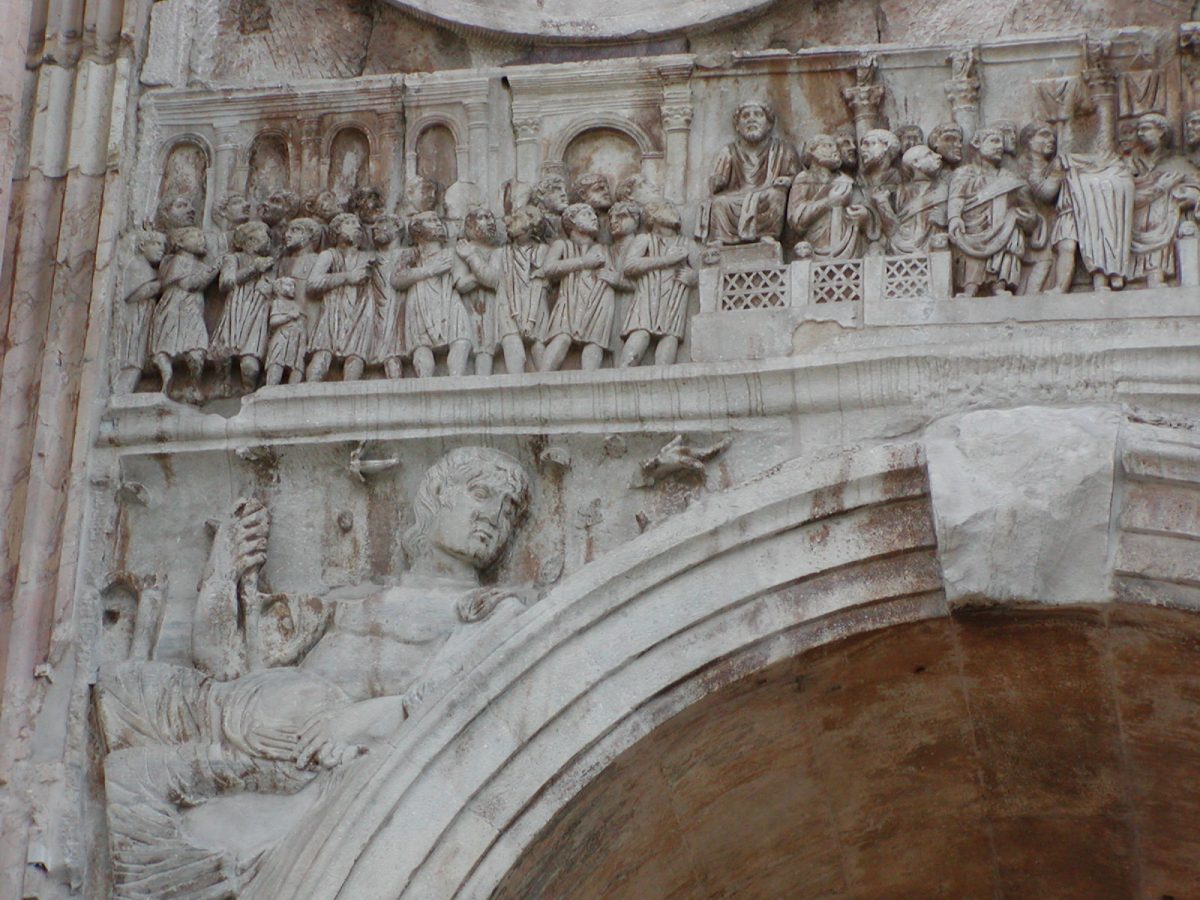
Main frieze, north side, left 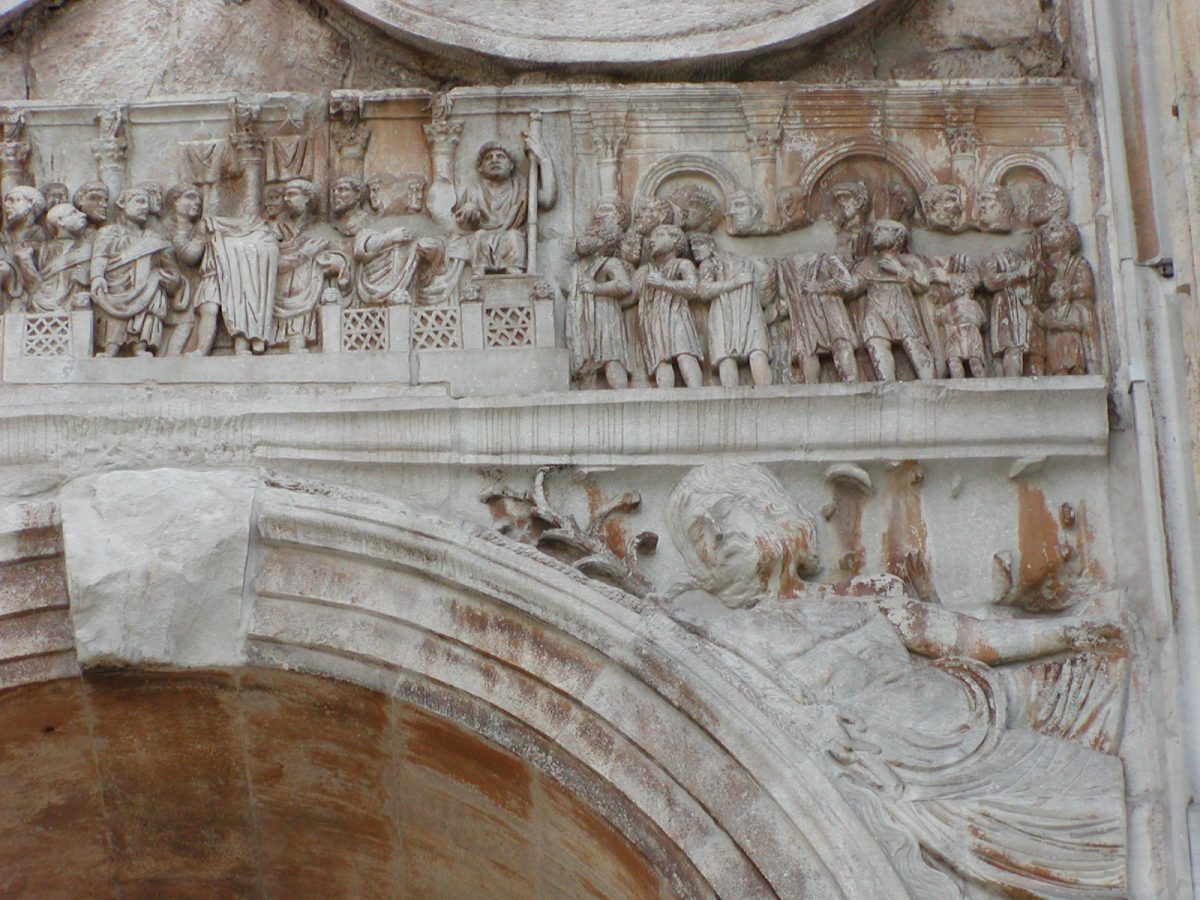
Main frieze, north side, left
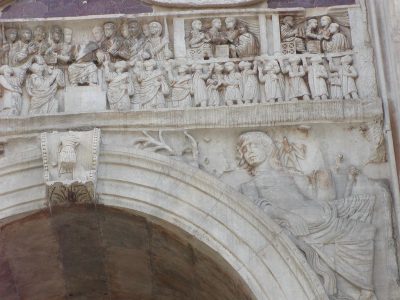
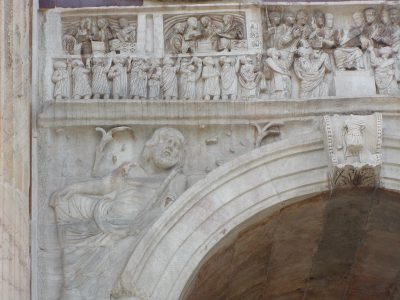
On the right, still on the N. face, Constantine is distributing money to the people, the congiarum. This ceremony was held in the Forum of Caesar on January 1st, 313 CE. Constantine is sitting on the throne in the centre (his head is missing here too) surrounded by toga clad dignitaries. On both sides the people of Rome is receiving the hand-outs from officials sitting in the rooms (probably the tabernae of the forum) shown above them.
Main frieze, north side, right 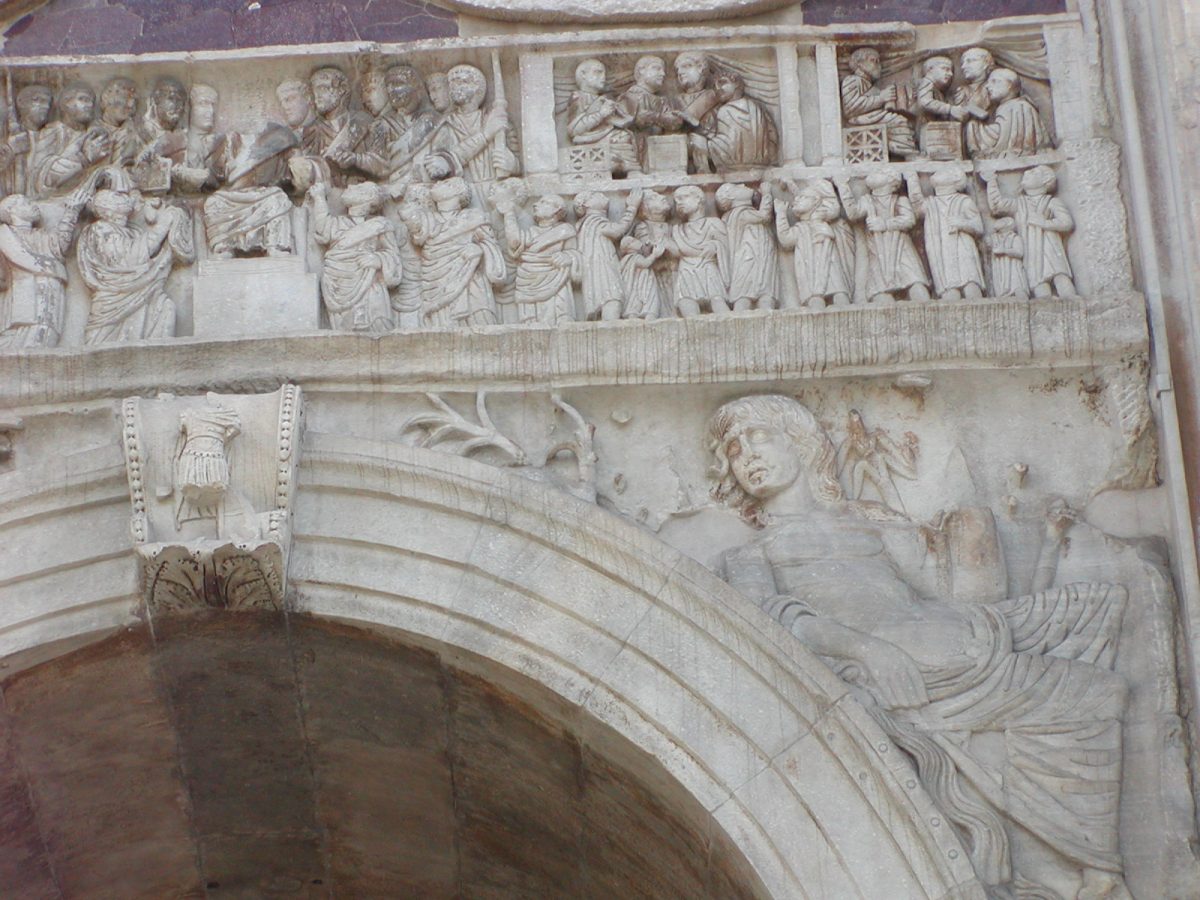
Main frieze, north side, right
Column Bases, Spandrels and Roundels
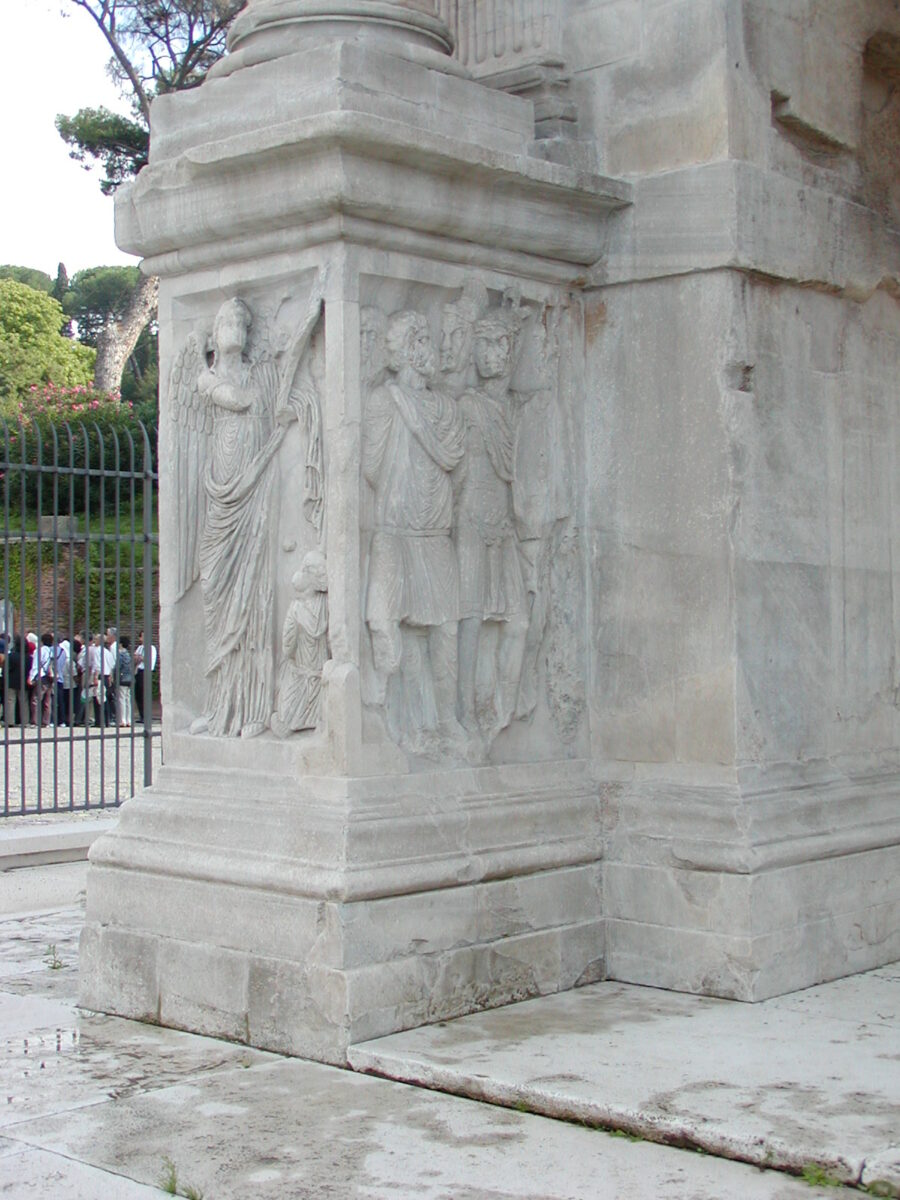
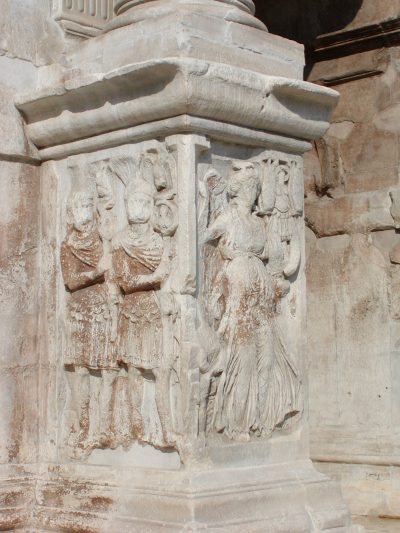
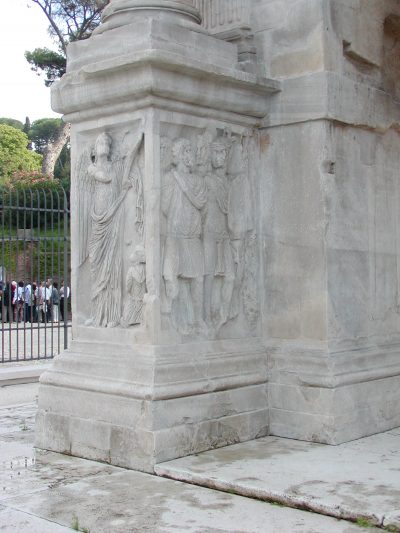
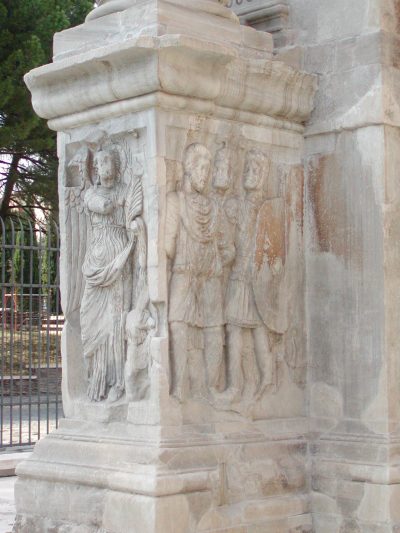
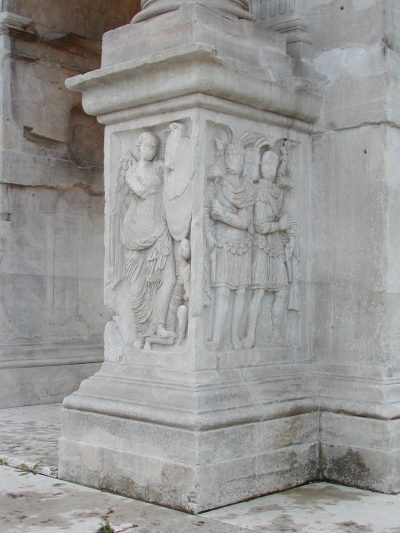
The bases for the eight Corinthian columns are sculpted on three sides. The front of each plinth has a relief of Victoria, the winged goddess of victory, carrying various symbols of triumphs while subdued prisoners sit at her feet. On both sides of the plinths there are reliefs of captured enemies and victorious soldiers.
Sculpted plinth, north side 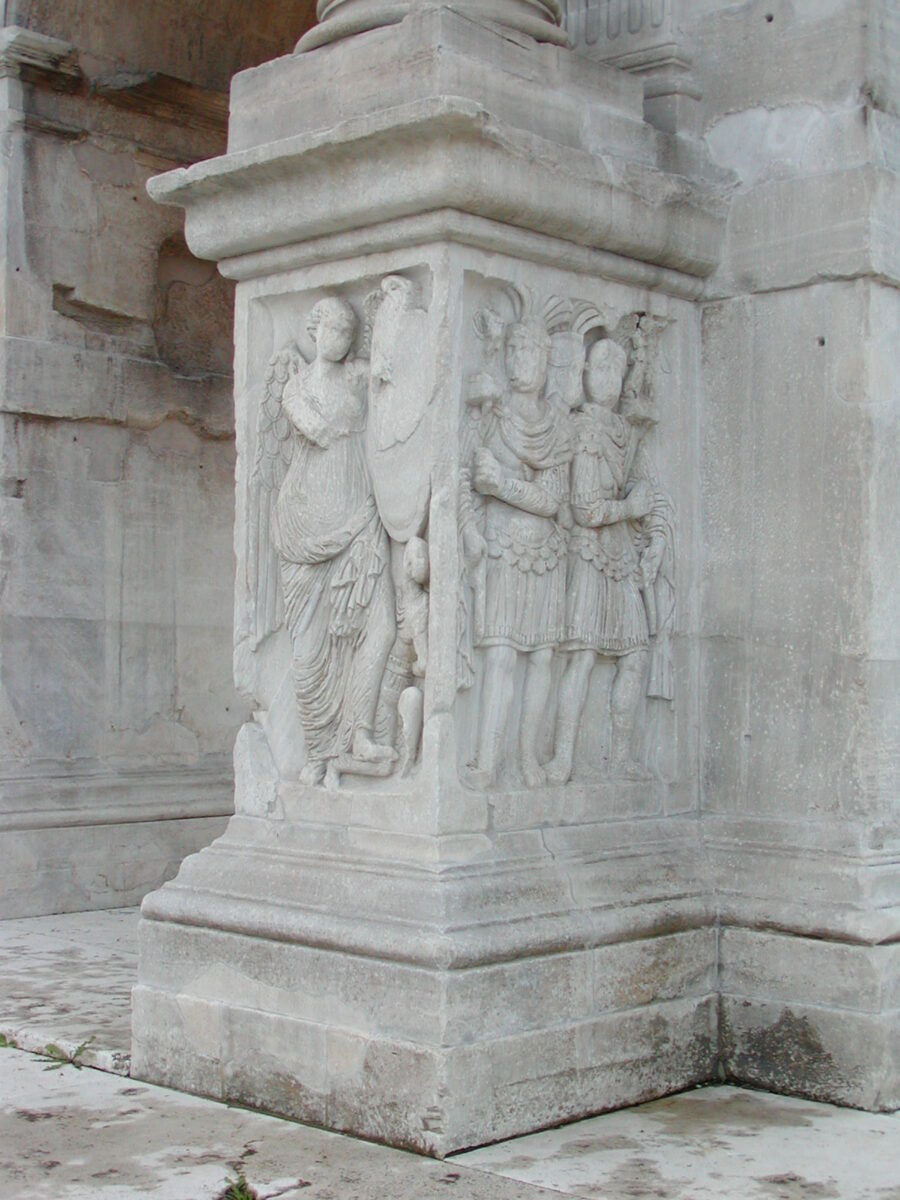
Sculpted plinth, north side 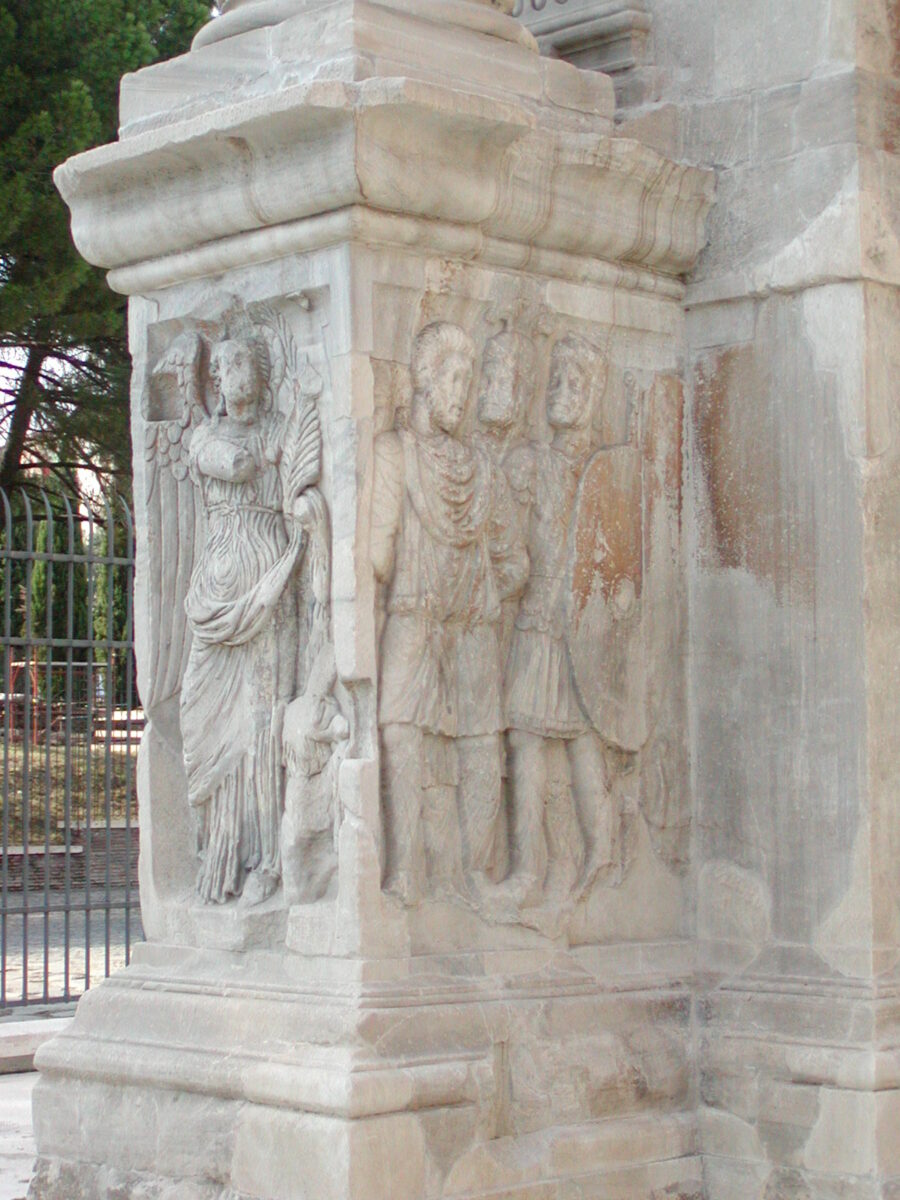
Sculpted plinth, south side 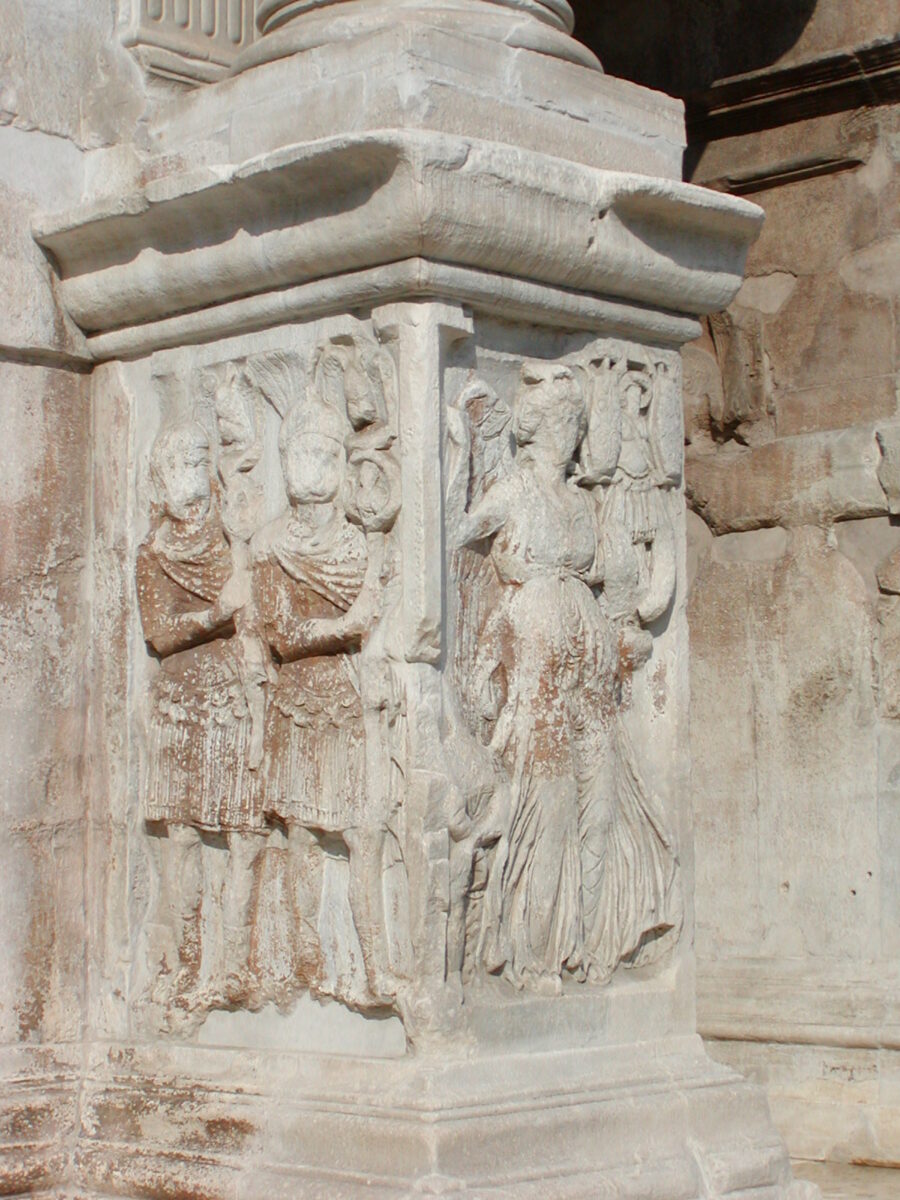
Sculpted plinth, south side
In the walls inside the lateral passageways are inserted a total of eight portrait busts, two in each wall, but they are so poorly conserved that they are unrecognisable.
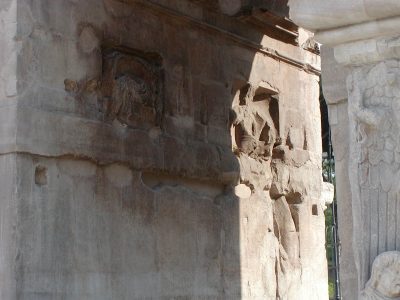
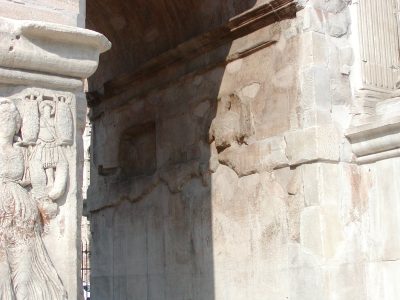
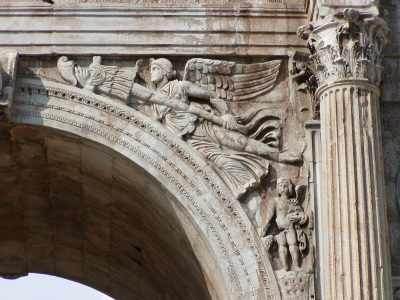
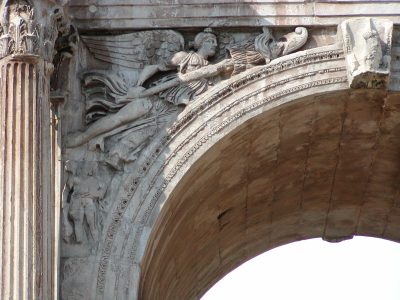
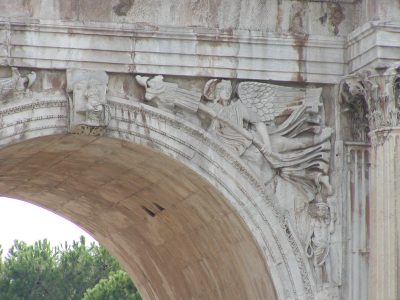
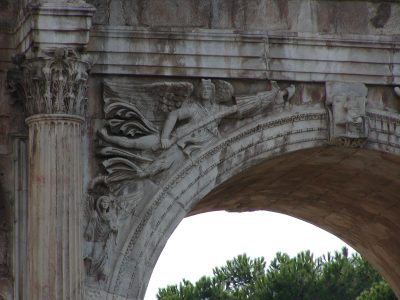
As is customary with triumphal arches, the spandrels of the central archway are decorated with images of the goddess Victoria presenting signs of victory, in the form of poles with the armour and weapons of the defeated, to the images on the keystones. Unfortunately, these images are deteriorated and unrecognisable. On the spandrels of the lateral passageways there are depictions of fluvial divinities.
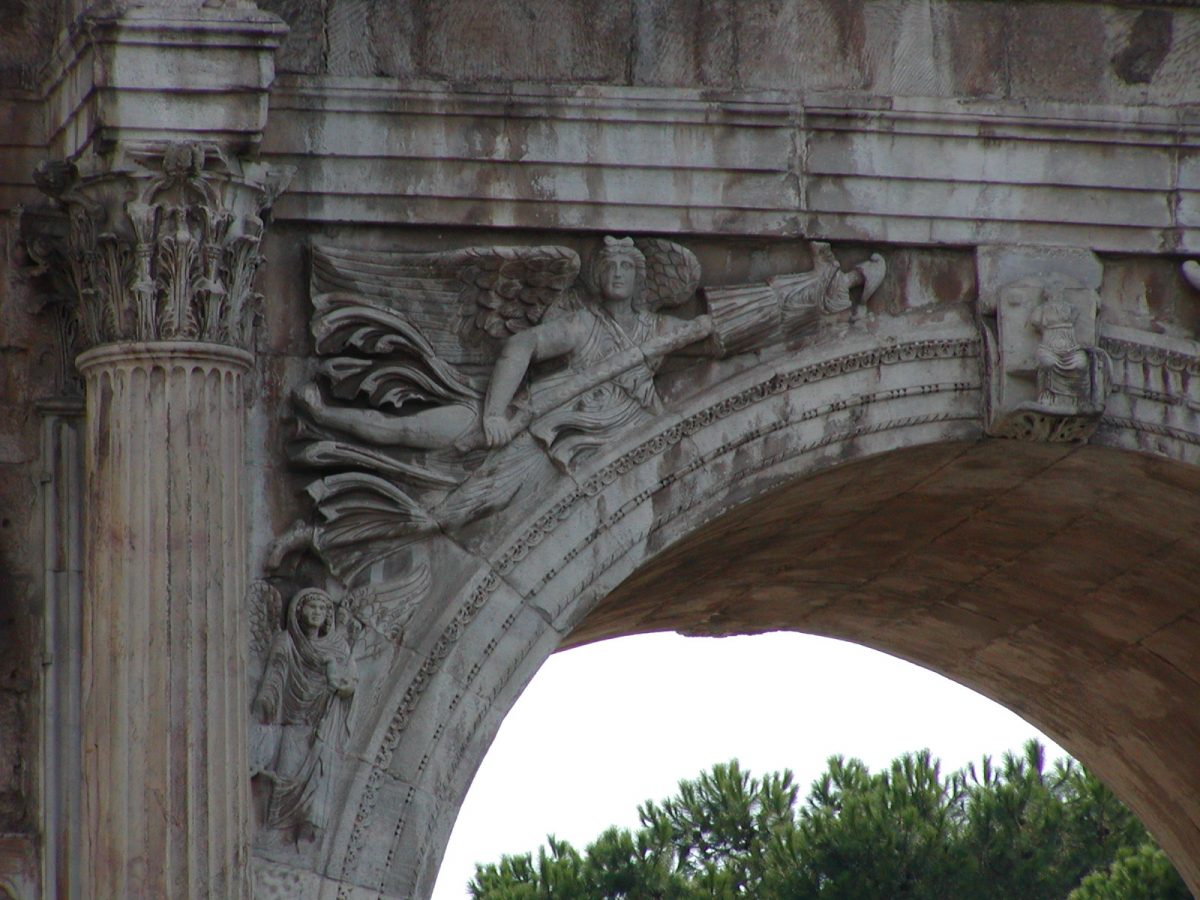
Central archway, north face, left 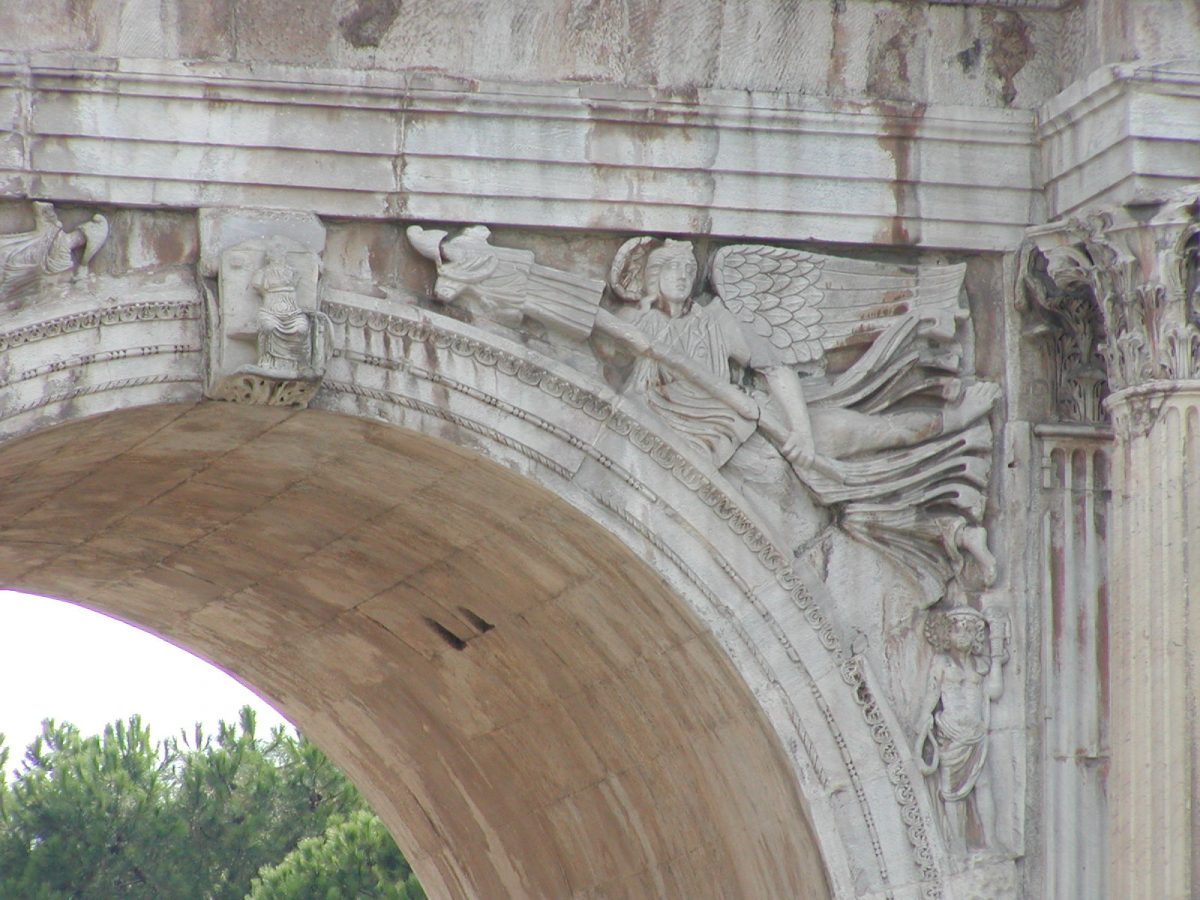
Central archway, north face, right 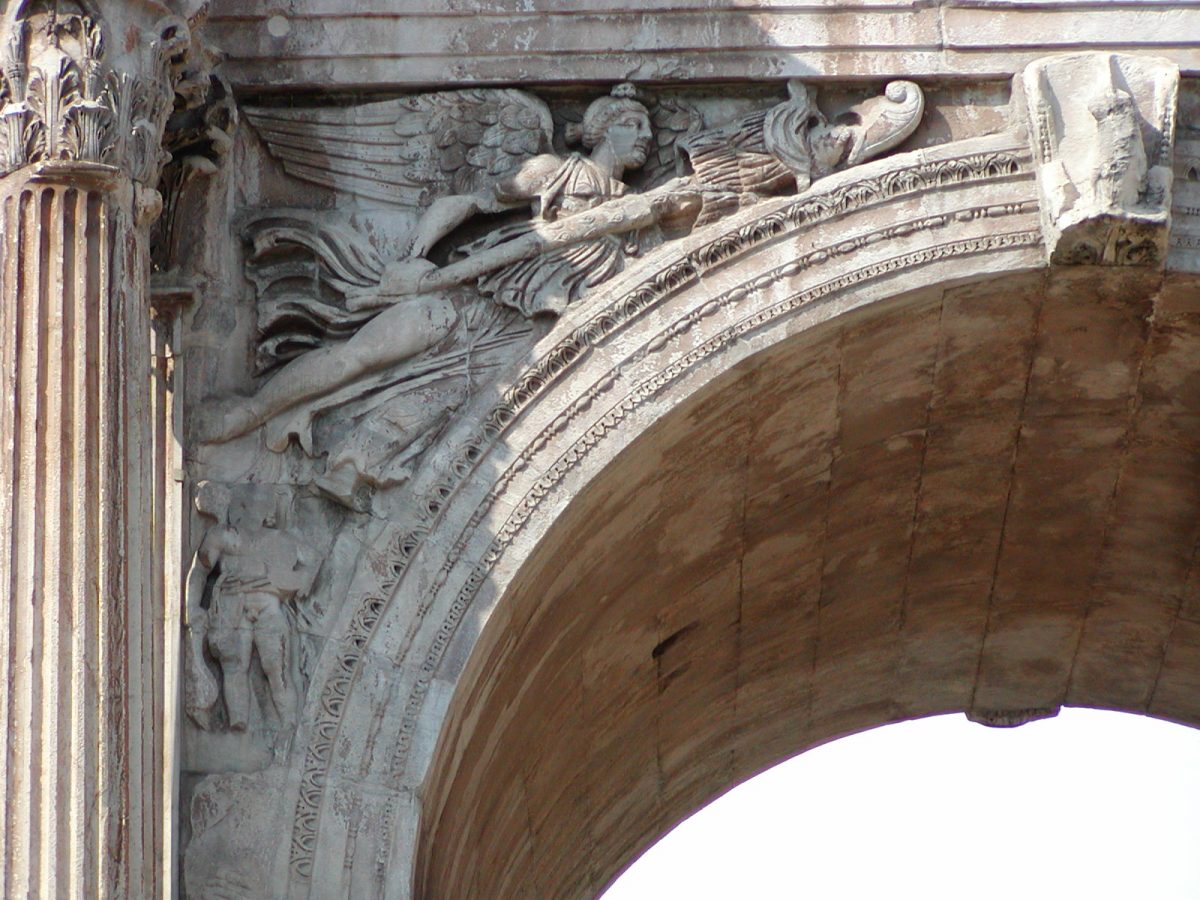
Central archway, south face, left 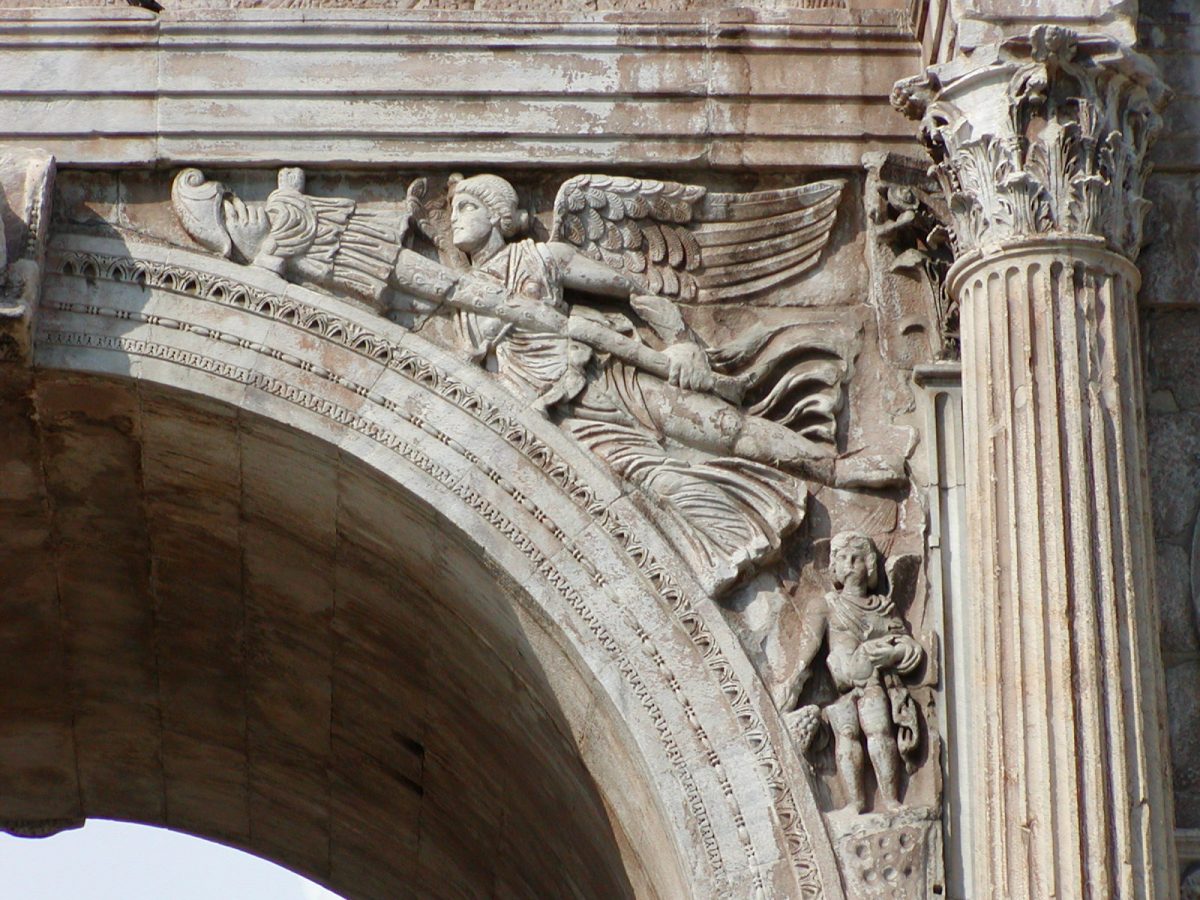
Central archway, south face, right
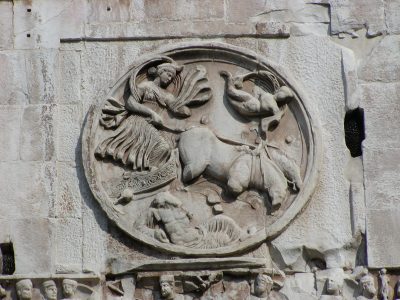
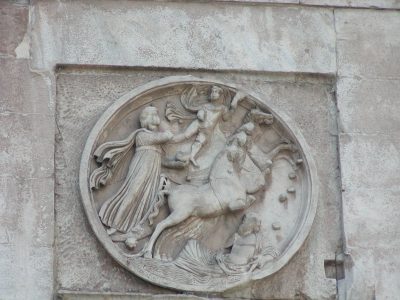
There are two other roundels on the Arch of Constantine, besides the eight Hadrianic Roundels. They are placed on either end of the arch. On the E. side the roundel shows a representation of the Sun god on his quadriga (four-horse chariot), while the roundel on the W. side shows the moon, Luna, on a biga (two-horse chariot).
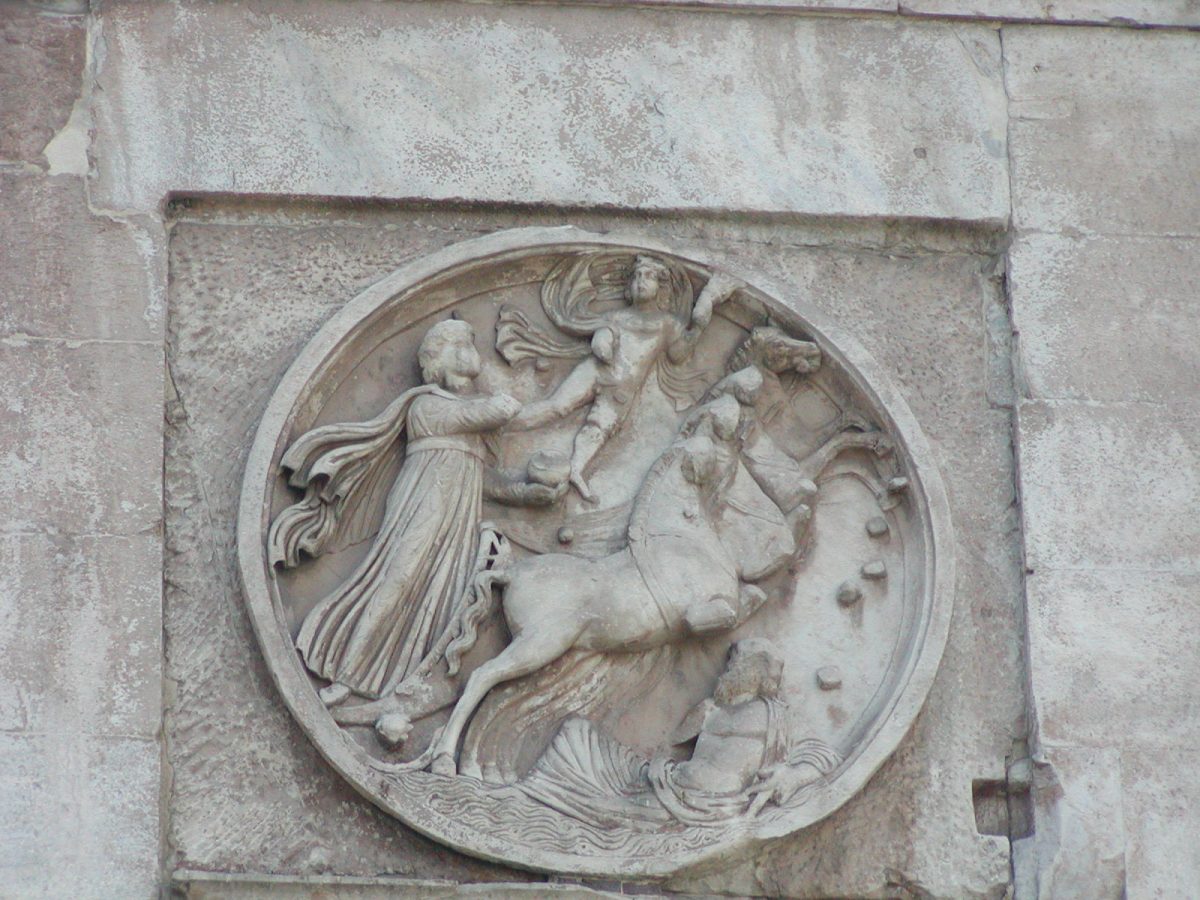
Roundel shows a representation of the Sun god on his quadriga 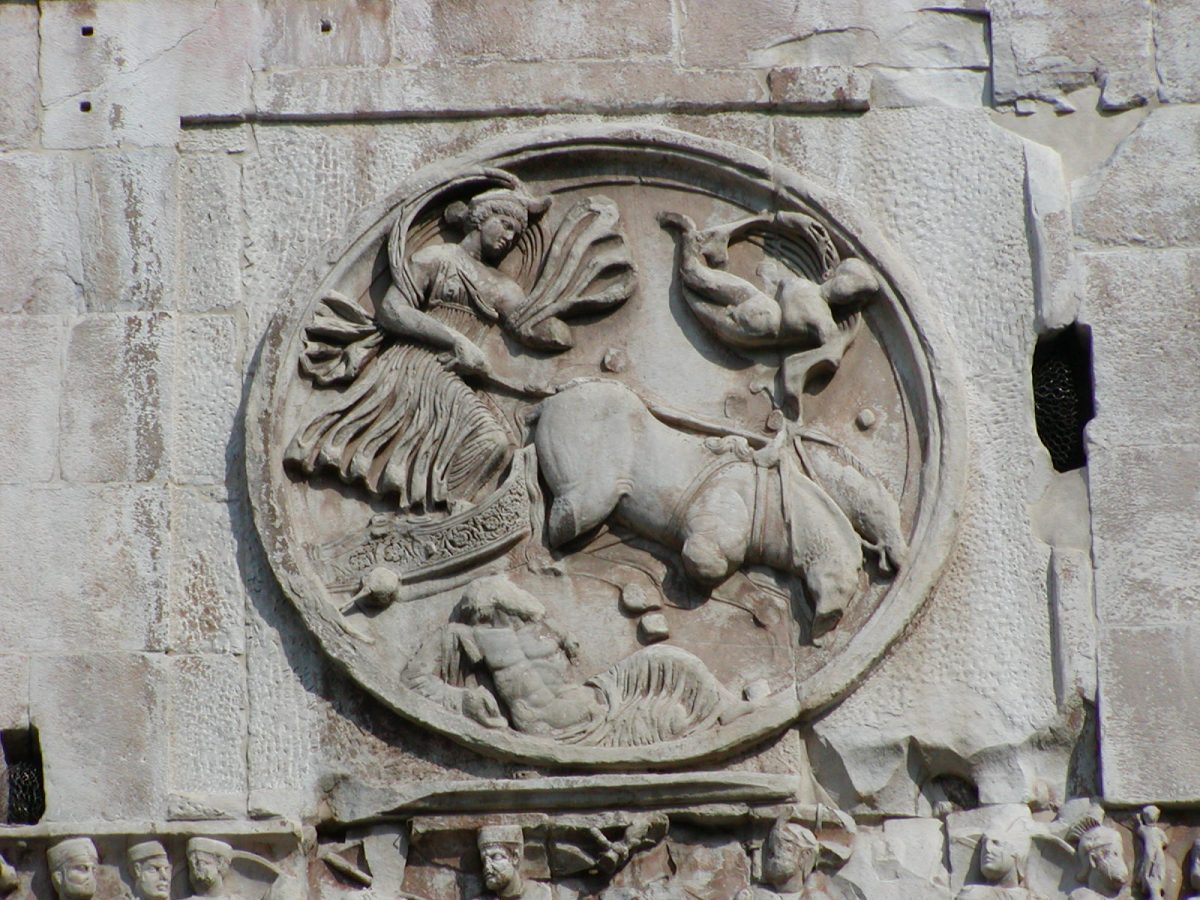
Roundel showing the moon goddess Luna on a biga
Changes in Artistic Style
The change in artistic style when compared to the earlier works is clear.
The Hellenistic naturalism of the classic imperial period has given way to a much more symbolic approach. Persons and monuments are no longer shown in they normal sizes and proportions as dictated by perspective and depth in the composition. Instead the sizes of the figures are dictated by the importance of each person, the emperor being physically bigger than the dignitaries, who in turn are bigger than the commoners.
-x “$php”Sizes and relative position of monuments in the background have been changed to utilise the available space completely, often totally sacrificing perspective. Physical appearance of the individual figures is downplayed in return for a more symbolic representation.
Emphasis is less on “this is emperor Constantine“, and more on “this is the Emperor”. Frontality is used throughout the reliefs. Only the emperors are shown frontally, while the others face towards them in symbolic submission.
These changes away from the classic style are often described as a step backward for the arts, due to lack of skill and professionalism of the artists, but this is not so.
In the early 4th century, society and culture had changed profoundly since the time of Hadrian and Marcus Aurelius more than two centuries earlier.
Different ideas of power and authority had developed, and were expressed differently. The Constantinian artists did not simply try to copy their predecessors. Their artistic programme was different leading to a different result.
Antiquity was slowly fading away, and the first steps towards what will later be called the middle ages, had been taken. Some of the tendencies on the Arch of Constantine will only reach their full potential much later, first in Byzantium, later in Western Europe.
Why Reuse Parts of Old Monuments?
There are at least three different explanations for this reuse of parts of older monuments, and they are not necessarily mutually exclusive.
One possible explanation is lack of highly skilled artisans. At the start of the 4th century Rome had not been at the centre of government for some time, and without the presence of the imperial court the artistic workshops would have much less to do, and hence be fewer.
Another possibility for the reuse is lack of time. The period from Constantine‘s first appearance in Rome (312 CE) and the tenth anniversary of his ascent to power (315 or 316 CE) left little time for the execution of the numerous sculptures and reliefs needed for the monument.
The third possible explanation for recycling is a desire to place Constantine in the same group of emperors as Trajan, Hadrian and Marcus Aurelius, who are also known as the Good Emperors, because they brought peace, prosperity and safe succession to the empire. This might be flattery or wishful thinking on behalf on the senate, or it might be a part of the self-image Constantine wanted such a monument to reflect.
Neither of these possible explanations exclude any of the other, so any combination of them is also a possibility.
Is the arch itself recycled?
There is a somewhat heated academic debate about the relation between the present day monument and what might have occupied the spot before. The traditional view, and the view most often repeated, is that the arch was built anew in the years 312-215 CE using in part spolia from older monuments and in part artwork made for the occasion for the decoration.
Various archaeologists have argued that almost the whole arch is recycled. Excavations in the late 1990s [Conforto 2001] have revealed older foundations below the current, dating from the time of Domitian.
It is known from written sources that Domitian erected arches to his own honour, but if the remains below the Arch of Constantine is from one of these, then the arch was either been torn down following the damnatio memoriae inflicted on Domitian after his death or it was dilapidated and abandoned.
The next level of foundations found was dated to the time of Hadrian, but they are the foundations of the current arch! If this is correct, at least the lower parts of the current arch must be from the time of Hadrian.
No ancient sources mention an arch erected by Hadrian, but neither do they mention the Arch of Constantine. The theory is supported by the fact that the only pieces of spolia that do not appear to have been remounted in a new location are the Hadrianic Roundels. According to this theory they have never been removed.
There are further evidence that an existing arch has been modified to make the Arch of Constantine. The lower parts, including the arches, are made in opus quadratum of very high quality, but the attic is made of opus latericium covered with marble slabs. There is little reason to change construction technique like that if the whole structure is made at the same time. Hence, the lower parts are Hadrianic, while the attic is Constantinian.
There are also signs that the eight columns were originally attached to the arch itself, and later detached from the main mass of the arch by moving the bases and extending the cornice around the top to accommodate the extra distance. This intervention can be deduced from small changes in the way the cornice is made. It is possible that an error had crept in while constructing the Arch of Constantine and the columns had to be moved, but it is more likely another sign that the the Arch of Constantine is a modification of an earlier arch that had the columns attached.
This theory (and others like it) is not uncontested. It has also been argued [Pensabene 1999] that the arch is the first major monument at that spot, and that even the works of art from the time of Constantine are spolia from another Constantinian monument.
Literature
Patrizio Pensabene e Clementina Panella (eds.): Arco di Costantino: tra archeologia e archeometria, “L’Erma” di Bretschneider, Roma, 1999.
Conforto, Maria Letizia (et al.): Adriano e Costantino. Le due fasi dell’arco nella Valle del Colosseo, Milano, Electa, 2001.
Filippo Coarelli: Roma, Guide Archeologiche Laterza, Laterza, Roma, 2001.
Amanda Claridge, Judith Toms, Tony Cubberley: Rome: an Oxford Archaeological Guide, Oxford Paperbacks, 1998.
About the Photographs
Most of the photographs below are taken on September 4th, 2002 and represent a tour around the arch. Each side is first photographed in full, followed by the details, moving (mostly) left to right. The different sides of the arch are photographed in this order: north, west, south and east.
Photo gallery for "Arch of Constantine"
There are 65 photos in this gallery.
-
Arch of Constantine - Main frieze, east side -
Arch of Constantine, sculpted plinth -
2002-09-04-161443 -
2002-09-04-161250 -
2002-09-04-161246 -
2002-09-04-161239 -
Arch of Constantine - Main frieze, west side -
Arch of Constantine - Roundel showing the moon goddess Luna on a biga -
2002-09-04-161200 -
2002-09-04-161041 -
Arch of Constantine - Main frieze, north side, right -
Arch of Constantine - Main frieze, north side, right -
2002-09-04-160858 -
2002-09-04-160832 -
2002-09-04-160752 -
2002-09-04-160736 -
2002-09-04-160638 -
Arch of Constantine, sculpted plinth -
2002-09-04-160610 -
2002-09-04-160539 -
2002-09-04-160527 -
Arch of Constantine - Main frieze, north side, lrft -
Arch of Constantine - Main frieze, north side, left -
2002-09-04-160424 -
2002-09-04-160418 -
Arch of Constantine - Reliefs from the time of Marcus Aurelius -
Arch of Constantine - Main frieze, east side -
Arch of Constantine - roundel shows a representation of the Sun god on his quadriga -
2002-09-04-162242 -

2002-09-04-162148 -
2002-09-04-162136 -
Arch of Constantine, sculpted plinth -
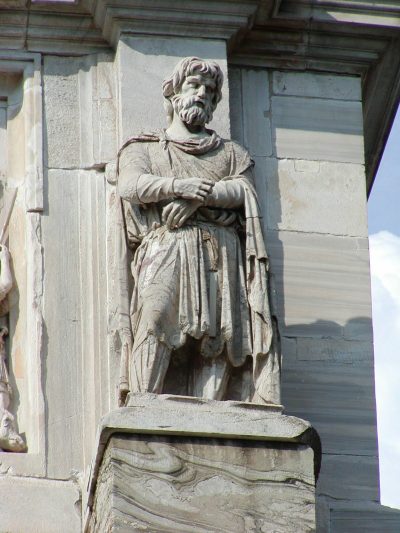
Dacian prisoners on the Arch of Constantine -
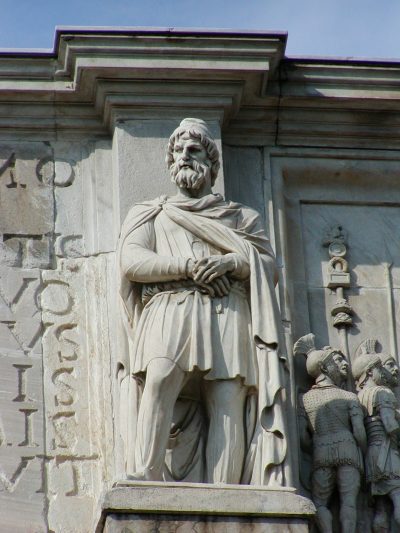
Dacian prisoners on the Arch of Constantine -
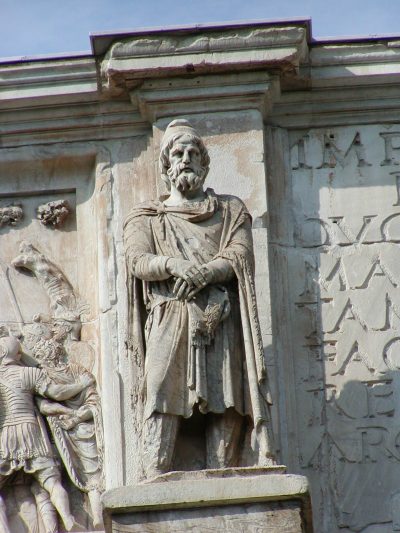
Dacian prisoners on the Arch of Constantine -
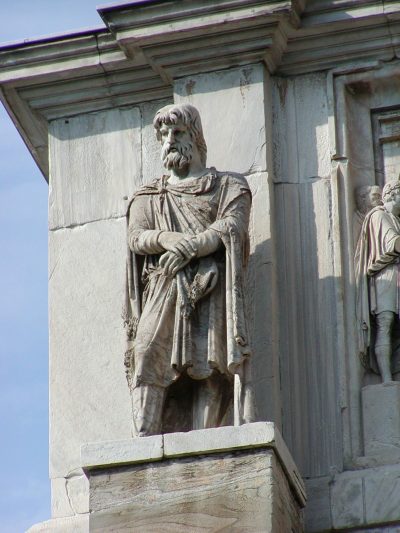
Dacian prisoners on the Arch of Constantine -
2002-09-04-161840 -
Arch of Constantine - main frieze, south side, right -
Arch of Constantine - main frieze, south side, right -
2002-09-04-161812 -
2002-09-04-161806 -
2002-09-04-161744 -
Arch of Constantine - central archway, south face, right -
Arch of Constantine - central archway, south face, left -
The inscription on the Arch of Constantine -
2002-09-04-161538 -
2002-09-04-161519 -
2002-09-04-161513 -
2002-09-04-161506 -
2002-09-04-161500 -
Arch of Constantine, sculpted plinth -
2002-09-04-160247 -
2002-09-04-160239 -
Arch of Constantine - central archway, north face, right -
Arch of Constantine - central archway, north face, left -
2002-09-04-160220 -
Arch of Constantine - artistic styles of the times of Hadrian and Constantine confronted -
piranesi097 -
piranesi018 -
1992-08-17-019 -
2002-09-04-162531 -
The Arch of Constantine in Rome -
2002-09-04-160045 -
2002-09-04-160138 -
tempesta004
Pages related to "Arch of Constantine"
- Antinous
- Antoninus Pius
- Apollo
- Arch of Septimius Severus
- Arch of Titus
- Basilica Julia
- Basilica Ulpia
- Colosseum
- Column of Marcus Aurelius
- Commodus
- Constantine I
- Diana
- Domitian
- Forum of Trajan
- Forum Romanum
- Hadrian
- Hercules
- Luna
- Marcus Aurelius
- Maxentius
- Meta Sudans
- Palatine Hill
- Ponte Milvio
- Silvanus
- Trajan